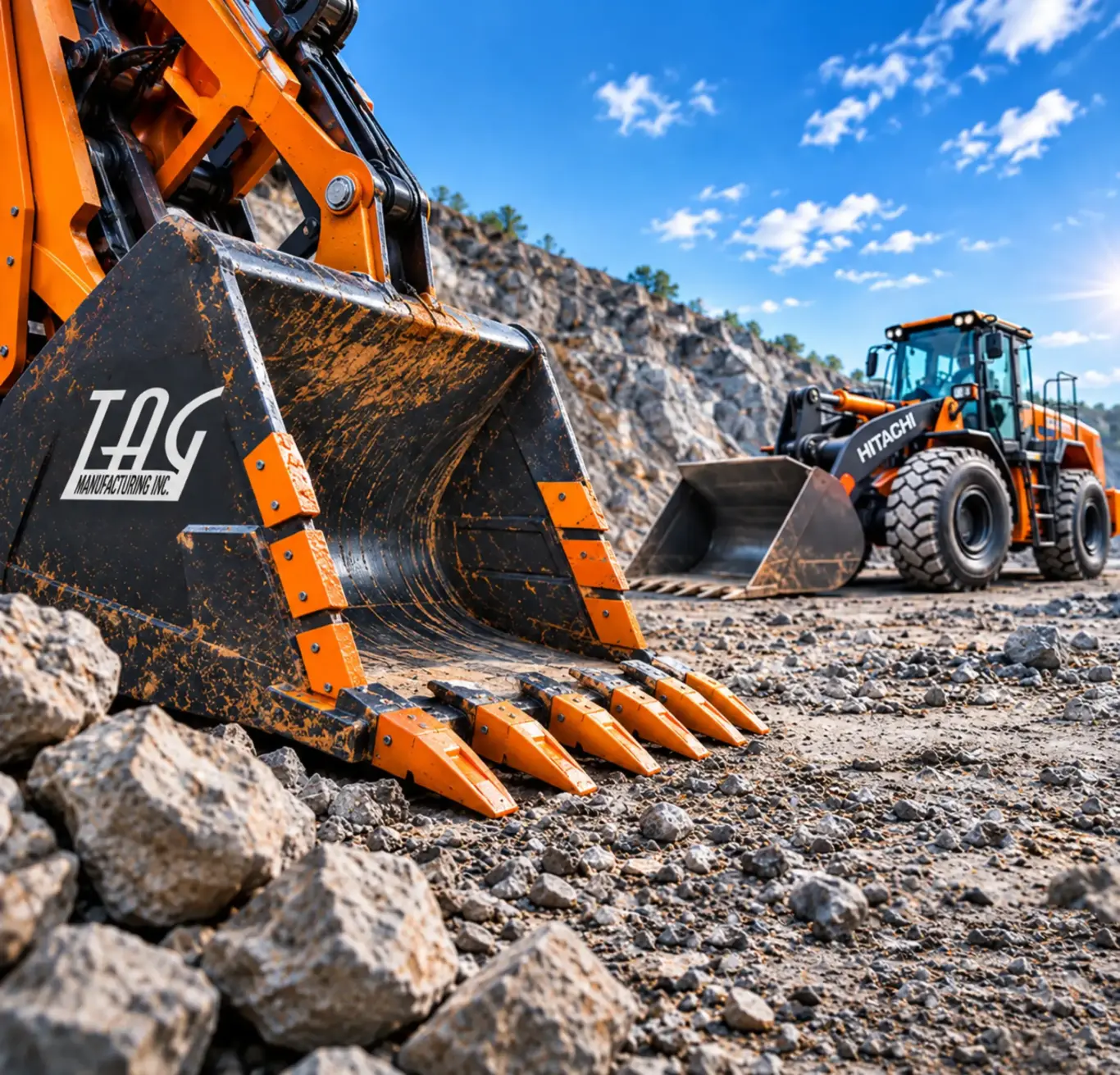
Choosing the right excavator bucket for your application can be tough, but we’re here to help. We build every bucket in this guide in Chattanooga, Tennessee. You can see the full TAG excavator bucket lineup on our site.
When choosing an excavator bucket, every operator must make three decisions: what the ground demands, what the machine can handle, and what the bucket attaches to. Make those calls in that order and you avoid the two most expensive mistakes: a bucket that wears out too fast and a bucket that doesn’t fit.
This guide walks through each decision, explains the parts of a bucket, and gives you a table that matches your ground to the TAG bucket that fits. Nine shorter guides, linked along the way, go deeper.
How Do You Choose an Excavator Bucket? Start With Three Decisions
Work through the three decisions in order, because each one builds on the one before it. A bucket that fits your coupler is still the wrong bucket if the ground wears it out too fast.
Decision 1: What are you digging? Topsoil, loam, fill, and ordinary clay are forgiving. High-silica sand, compacted clay, sharp gravel, rubble, blasted rock, and frozen ground are not. The harder the material is on steel, the more wear steel you need between the ground and the structural shell. That’s the idea behind our three duty classes: Heavy Duty, Severe Duty, and SXD (Severe Xtreme Duty), part of our Xtreme Duty line.
Decision 2: What machine is it going on? Your machine determines the pin size, the ear spacing, the width it can push without stalling, and the weight it can lift with a full load inside. A bucket that is too wide digs slowly, and one that is too heavy steals lift capacity.
Decision 3: How does it attach? The coupler on the machine sets the interface the bucket needs. A bucket built for one coupler pattern won’t fit another.
Getting any of the three wrong costs you slow cycles, early repairs, or downtime. A bucket is one of the cheapest pieces of equipment on the job, so it’s not the place to guess.
What Are the Parts of an Excavator Bucket and What Do They Do?
An excavator bucket is a steel box with a cutting edge, teeth, side cutters, and a pair of bucket ears that pin it to the stick. Teeth, cutting edges, side cutters, wear strips, and side plates are meant to be sacrificial. Replace them on time and the structure behind them stays protected.
Shell. The shell is the curved floor and back of the bucket. It carries the load and takes the abrasion. On our Heavy Duty, Severe Duty, SXD, ditch cleaning, tilting, and TAG QC buckets, the shell is a double bottom: an outer wear skin over an inner structural shell, so wear on the outside doesn’t breach the structure. Internal triangle reinforcements keep the shell of our Heavy Duty, Severe Duty, and SXD buckets from twisting under load.
Cutting edge. The cutting edge is the front edge of the floor, where the bucket meets the ground. On a digging bucket, it carries the tooth adapters. On a ditch cleaning bucket, it is a smooth, double-beveled, reversible bolt-on edge that you can flip when one side wears. If a bucket that used to cut clean now skips across the ground, a rounded cutting edge is usually the reason.
Teeth and adapters. Teeth are the replaceable points that break ground, and adapters are the bases they lock onto. The adapters are welded to the cutting edge. The teeth are sacrificial, but the adapters are not.
Side cutters. Side cutters are plates on the leading edge of each sidewall. They shear the sides of the cut and protect the ends of the sidewalls. On a standard TAG tooth bucket, the side cutter extends below the cutting edge. On the Mass X, it does not.
Bucket ears, pins, and pin bosses. The bucket ears are the two plates on the back that pin the bucket to the stick and the link. The pins run through bushed bores in the pin bosses. Abrasion isn’t their main problem. Side loading and impact bend the ears, and pin movement wears the bores oval. That pin-bore wear shows up as a bucket that rattles and won’t hold a grade.
Wear strips and side plates. Wear strips are bars across the underside of the shell, usually at the heel, which is the back corner that drags when you curl and rake. Side plates do the same job on the sidewalls.
What Do Heavy Duty, Severe Duty, and SXD Mean?
An excavator bucket duty class is the amount of wear steel and reinforcement a bucket carries, matched to how abrasive the ground is. Moving up a class costs more and adds weight, but it pays off when the ground would wear a lighter bucket out too fast.
Ground conditions change wear rates, and quartz content is a big part of the reason. Quartz is far harder than the calcite in limestone, so the same bucket can wear slowly on one site and too fast on the next. The UK Health and Safety Executive’s silica guide shows how widely that content varies. Sandstone and quartzite are above 70 percent crystalline silica, granite is typically 30 percent, and limestone and chalk are usually under 2 percent. These are industry-general figures, not TAG specifications.
United Rentals sorts buckets by the same logic. A general-purpose bucket handles loose dirt, loam, and mixed gravel, while sand, crushed rock, broken slag, sandstone, iron ore, and high-quartz granite call for a heavy-duty or high-abrasion bucket. In our lineup, that high-abrasion end means Severe Duty and SXD, not our Heavy Duty class.
Sand can go either way, so the decision table splits it by how sharp, silica-rich, and wet it is. Limestone is low in quartz, but it’s still rock, so the table’s rock rows apply. [TAG to confirm: duty class for limestone quarry work, and whether slag and ore always call for SXD.]
Heavy Duty Bucket. The Heavy Duty Bucket is our bucket for general excavation, utility work, and site prep. Four structural features define it: double bottom shells, smooth and unobstructed openings, internal triangle reinforcements, and a double radius, dual taper profile. The smooth opening keeps sticky material from hanging up inside. The profile helps the bucket fill and dump cleanly, which means quicker loading and more yardage per pass.
The Heavy Duty Bucket can be ordered with bolt-on cutting edges, a choice of teeth, and wear shrouds, which are the guards that cover the cutting edge between the teeth. Extra wear parts can be added, but few buyers order them. A buyer who wants more protection usually steps up to a higher duty class instead.
Severe Duty Bucket. The Severe Duty Bucket is built for mini and compact excavators working in rock, concrete rubble, and compacted clay, where a standard bucket can wear out too fast. It carries larger internal triangle reinforcements, full-width replaceable transverse wear strips, extended bucket ears, and full side wear plates. All that extra steel makes it noticeably heavier than a Heavy Duty Bucket of the same width. [TAG to confirm: Heavy Duty and Severe Duty weights at the same width.]
SXD Bucket. The SXD Bucket is built for mining and extreme wear applications. It carries everything in the Severe Duty spec, plus a thicker shell and cutting edge. It also adds three parts of its own. Replaceable heel protectors cover the back corners, which tend to wear through first. Replaceable vertical shrouds cover the leading edges of the sidewalls, and torque tubes keep the bucket square under twisting loads.
The toughest calls come when your ground falls between Heavy Duty and Severe Duty. Picture a sandy site with sharp aggregate fill, a clay job that turns out to be compacted and full of cobble, or a demolition cleanup that was supposed to be dirt. Here’s the rule: if a Heavy Duty Bucket needed edge or tooth work sooner than expected on a job like that, make the next one a Severe Duty Bucket. The full comparison is in Heavy Duty vs Severe Duty vs SXD buckets.
Which Bucket Type Fits the Job?
The work in front of you sets the excavator bucket type, just as the ground sets the duty class. No single shape does every job well, so most mini and compact owners end up with at least two: a digging bucket for trenching and a wide ditch cleaning bucket for grading and backfill.
Digging Buckets
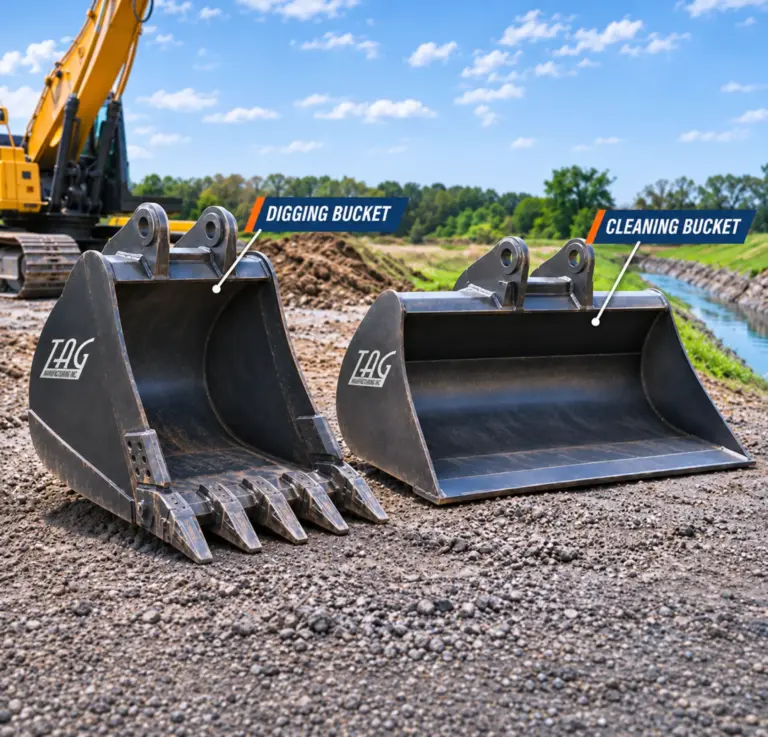
A digging bucket is the default for breaking ground and cutting trenches. It is narrower than it is deep, with teeth on the cutting edge, and it is built to carry a full bite. The Heavy Duty, Severe Duty, and SXD buckets above are all digging buckets in different duty classes.
Ditch Cleaning Buckets
A Ditch Cleaning Bucket is wide and shallow, with a smooth cutting edge and no teeth. It grades and cleans out ditches, culverts, and drainage channels in one pass instead of several bites with a digging bucket. Ours is built for excavators from mini to full size. It has the same double bottom shell and dual taper profile as the Heavy Duty line, internal rib reinforcements on wide widths, and a double-beveled, reversible bolt-on edge that takes the wear instead of the bucket floor.
Don’t use it to break hard ground. The smooth edge won’t penetrate, and the wide shell loads the hydraulics. Open the cut with a toothed digging bucket, and switch to the ditch cleaning bucket to shape, grade, and backfill. See ditch cleaning bucket vs digging bucket for when the wide bucket pays off.
Tilting Ditch Bucket
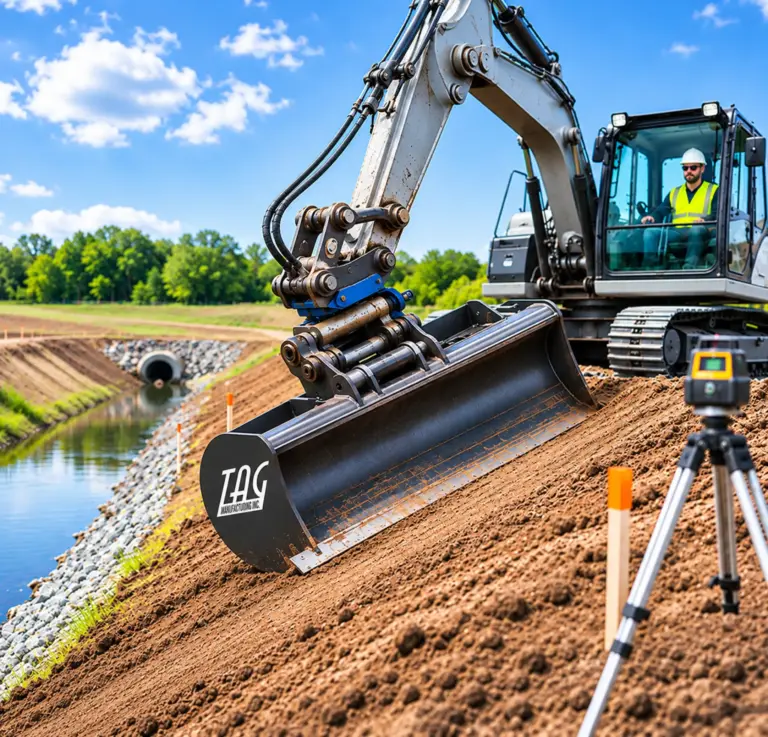
A Tilting Ditch Bucket is a ditch cleaning bucket with a dual-cylinder tilting top. It tilts 45 degrees left and right, so you can cut a sloped ditch wall, crown a road, or follow a grade across a slope without repositioning the machine. It shares the ditch cleaning bucket’s double bottom shell and reversible bolt-on edge.
The trade-off is cost and complexity, since you add cylinders, hoses, and a valve. If you cut sloped drainage every week, a tilting bucket pays for itself. You save time on repositioning, and every move you skip is less wear on your tracks, boom, and hydraulics. If you only cut a drainage ditch once in a while, a fixed ditch cleaning bucket will do. See tilt buckets for grading, slopes, and drainage.
Rock Buckets: V Bottom and Coral Rock
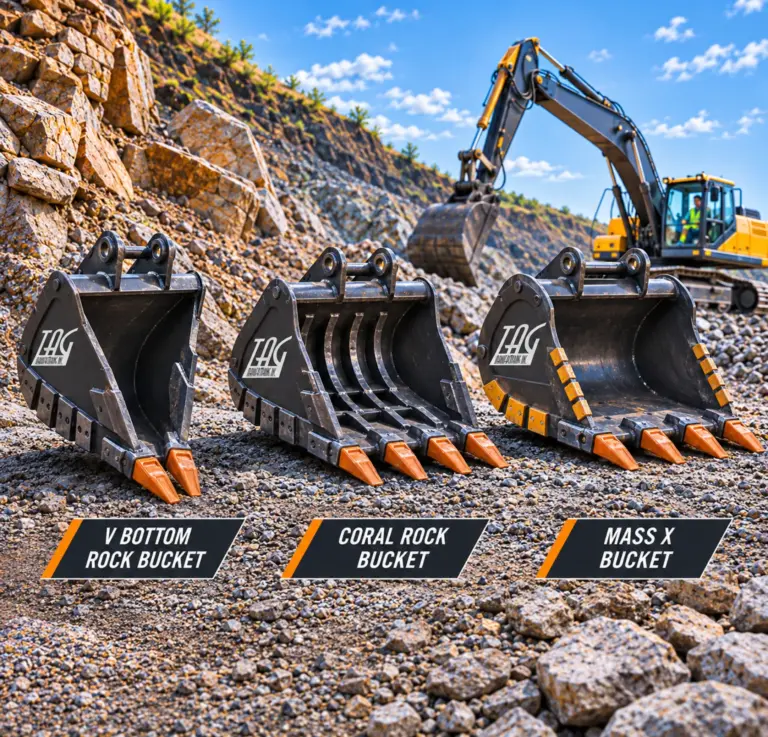
A V Bottom Rock Bucket has a V-shaped cutting edge with specialty rock teeth. The V concentrates breakout force on the center tooth, so the bucket penetrates hard-packed ground, rocky ground, and frozen surfaces that a straight cutting edge skates over. It is a penetration tool first and a carrying tool second.
A Coral Rock Bucket is a Severe Duty bucket designed for peeling coral rock. It carries additional teeth for increased penetration, weld-on replaceable wings for wear protection and peeling, and full side wear plates. The extra teeth shave rock in thin layers instead of breaking off a big bite.
If rock is a daily condition, these buckets do the job better than running a general bucket into it. If rock is an occasional layer, a Severe Duty digging bucket with the right teeth may be enough. See rock buckets for excavators: V Bottom, Coral Rock, and Mass X.
High-Capacity: Mass X
The Mass X Bucket is our high-capacity flat bottom bucket. It is built for moving volume in lighter material, where you want the biggest bite the machine can lift rather than the most penetration. An extended cutting edge gives it a deeper profile. AR450 plate, an abrasion-resistant steel in the 450 Brinell hardness class, is used in key wear areas.
The Mass X Bucket saves weight with a single bottom shell protected by wear strips. That matters on a high-capacity bucket, because every pound of bucket is a pound the machine can’t carry as load.
Coupler-Interface Buckets: TAG QC and OEM Style
A TAG QC Bucket is a Heavy Duty bucket built with the TAG QC interface instead of pin-on ears. It carries double bottom shells, internal tube reinforcements, smooth and unobstructed openings, and the double radius, dual taper profile. If your machine runs a TAG QC27 or QC30 coupler, this is the bucket that locks on without leaving the cab.
An OEM Style Quick Coupler Bucket is built for compact excavators with a factory John Deere Wedge, Kubota Quick Attach, or Bobcat X-Change coupler. It gives you a direct OEM-pattern interface with the same four Heavy Duty structural features. Use it for general excavation, utility work, and site prep when the machine keeps its factory coupler. The choice between the two is covered in TAG QC buckets vs OEM-style coupler buckets.
Decision Table: Ground Type to Duty Class to TAG Bucket
Use this table to go from your ground to a duty class, a bucket type, and the TAG product that fits.
| Your ground or job | Duty class and bucket type | TAG product |
|---|---|---|
| Topsoil, loam, fill, general excavation, utility trenching | Heavy Duty digging bucket | Heavy Duty Bucket |
| Ordinary sand, loose gravel, ordinary clay | Heavy Duty, or Severe Duty if the bucket is wearing too fast | Heavy Duty Bucket or Severe Duty Bucket |
| High-silica or sharp sand, or wet sand with a high water table, like Charleston’s | Severe Duty digging bucket [TAG to confirm: duty class for wet, high-silica coastal sand] | Severe Duty Bucket |
| Compacted clay, concrete rubble, cobble, broken rock (mini and compact) | Severe Duty digging bucket | Severe Duty Bucket |
| Compacted clay (full-size excavators) | [TAG to confirm: duty class for full-size excavators in compacted clay] | Ask the TAG Customer Success Team |
| Hard-packed ground, blasted rock, frozen ground | Rock bucket with a V-shaped edge and rock teeth | V Bottom Rock Bucket |
| Coral rock that needs peeling | Severe Duty coral rock bucket | Coral Rock Bucket |
| Mining, slag, quartzite, ore, extreme abrasion | SXD bucket | SXD Bucket |
| Light material, bulk moving, maximum volume per pass | High-capacity flat bottom bucket | Mass X Bucket |
| Ditches, culverts, drainage channels, finish grading, backfill | Wide ditch cleaning bucket with a smooth edge | Ditch Cleaning Bucket |
| Sloped ditch walls, sloped drainage work, crowned grades | Ditch cleaning bucket with hydraulic tilt | Tilting Ditch Bucket |
| Any of the above, on a TAG QC coupler | Heavy Duty bucket with TAG QC interface | TAG QC Bucket |
| Any of the above, on a Deere Wedge, Kubota Quick Attach, or Bobcat X-Change coupler | Heavy Duty bucket with OEM-pattern interface | OEM Style Quick Coupler Bucket |
How to read this table: Start with the row that matches your ground, and then check the last two rows for your coupler. Duty class comes from the ground, and the interface comes from the coupler, so the two choices are independent.
How Wide Should the Bucket Be?
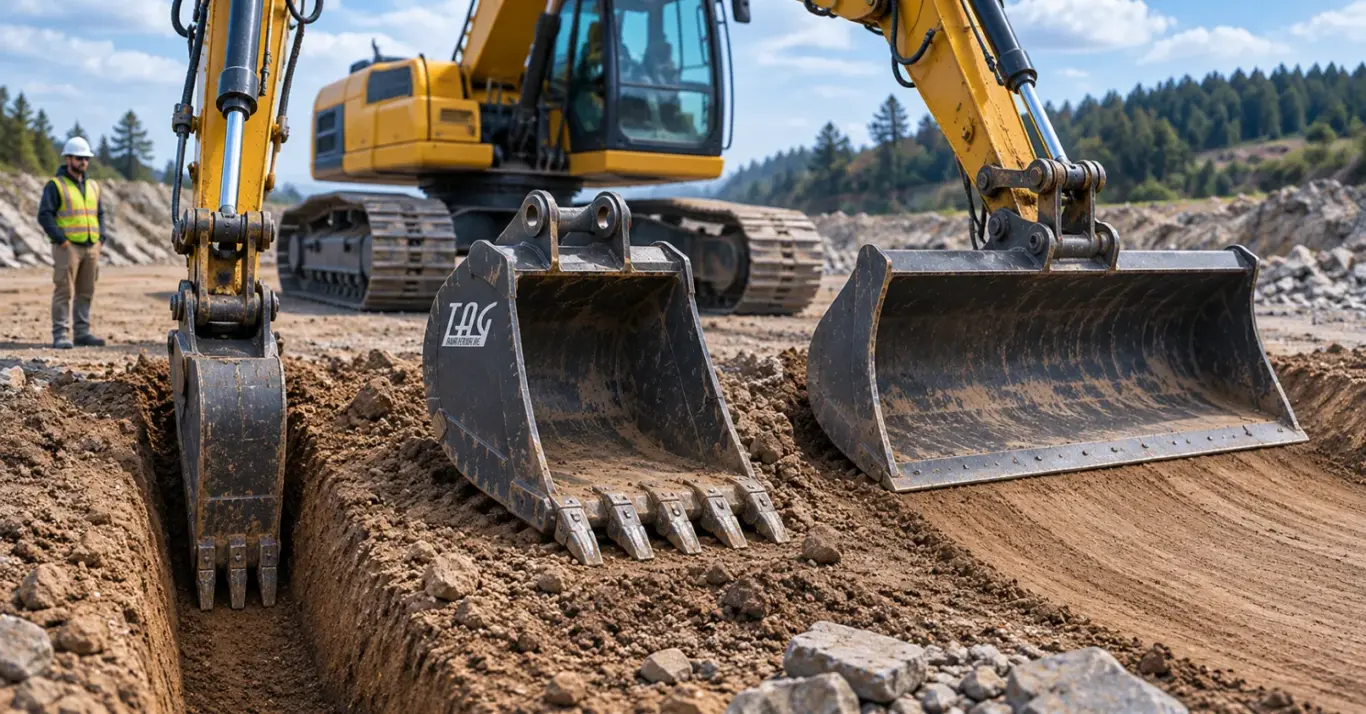
For a digging bucket, the trench sets the width. Pick the narrowest bucket that cuts the trench you need, because a narrower bucket digs faster. For a ditch cleaning bucket, go as wide as the machine can push without stalling. Both limits scale with machine weight, so sizing starts with the tonnage on the decal.
The United Rentals excavator bucket size chart gives these approximate industry ranges. It has no row for 10 to 15 ton machines, so that row shows the standard bucket on Sunbelt Rentals’ 30,000 lb class excavators, which weigh about 13 to 14 metric tons.
| Machine weight | Digging bucket width | Grading or ditching bucket width |
|---|---|---|
| 1 to 1.9 ton | 6 to 24 inches | 36 inches |
| 2 to 3.5 ton | 9 to 30 inches | 36 inches |
| 4 to 6 ton | 12 to 36 inches | 36 to 48 inches |
| 7 to 10 ton | 12 to 36 inches | 48 to 60 inches |
| 10 to 15 ton | About 36 inches (standard rental bucket) | Not listed |
| 15 to 25 ton | 18 to 48 inches, up to 60 inches from 20 tons | 60 inches |
These are industry-general ranges, not TAG specifications. United Rentals also advises staying within the bucket widths your excavator’s manufacturer recommends. [TAG to confirm: standard width range for Heavy Duty and Ditch Cleaning buckets by machine class, including the 1 to 6 ton class.]
Breakout force comes from the machine’s hydraulics, not the bucket, so a bigger bucket doesn’t dig harder. Load weight is the other limit. A full bucket of wet clay or stone weighs far more than one of dry loam, so check any bucket and load combination near the machine’s rated lift capacity against the lift chart. [Engineering review required]
For sizing by machine class, see excavator bucket width by machine size.
Will the Bucket Fit Your Coupler?
A bucket fits when its interface matches what is on the end of the stick. That means pin-on ears for a bare stick or a pin-grabber coupler, a TAG QC interface for a TAG QC coupler, or the matching OEM pattern for a factory OEM coupler.
For pin-on and pin-grabber setups, three measurements decide fit: pin diameter, the inside width between the ears, and the center-to-center distance between the pins. Measure the machine, not the old bucket, because the old bucket may be worn or may have been a compromise fit to begin with. [TAG to confirm: pin diameter and ear spacing ranges TAG QC27 and QC30 couplers accept.]
For dedicated couplers, the pattern is the whole story. The TAG QC27 is built for mini and compact machines, and the QC30 is built for heavier attachments on full-size excavators. A TAG QC Bucket won’t fit a Deere, Kubota, or Bobcat coupler, and an OEM Style bucket won’t fit a TAG QC coupler.
When Should You Replace an Excavator Bucket?
Replace an excavator bucket when the structure is worn out, not just the wear parts. That means the shell has worn thin, the welds have cracked, the ears have bent, or the bores have worn oval. Everything before that point is maintenance. The expensive mistake is letting cheap wear parts go until they take the structure with them.
Check these four points:
- Teeth: Industry guidance published by Construction Equipment says to replace them before the adapter is exposed. Once the wear reaches the adapter, a simple tooth change turns into a cut-and-weld job.
- Cutting edge: Flip a reversible edge when the first side rounds over, and replace it before the second side rounds over.
- Welds and pin bosses: Look for cracks along the welds or around the pin bosses.
- Shell: Look for holes or thin spots in the floor and heel.
The first two are wear-part jobs. The last two mean the structure itself is wearing, so call us about repair or replacement. [TAG to confirm: TAG’s recommended replacement points for teeth, cutting edge, side cutters, and shell wear.]
Don’t patch a crack and put the bucket back to work. A crack keeps spreading under a patch weld, and the patch hides whatever caused it. Have the crack repaired with proper weld preparation, and fix the cause before the bucket goes back in the ground.
Most structural damage comes from impact and overload, not abrasion. The habits behind it are side loading, prying, digging with a worn cutting edge, using the bucket as a hammer, and overloading. If a bucket cracks or its ears bend, look at how it’s being run as well as what it’s digging.
The wear pattern also tells you whether you chose the right duty class. If the heel and sides wear faster than the cutting edge, the ground is more abrasive than the bucket was built for, and it’s time to step up to a higher duty class. If teeth break instead of wearing down, the material is harder than the tooth profile suits.
For a part-by-part look at how wear happens, see why excavator buckets wear out. For a ten-minute walk-around with a tape and a straightedge, use the excavator bucket inspection checklist.
What Does the TAG Warranty Cover?
We warrant new TAG products to be free from defects in material and workmanship for one year from the date of original purchase. Our liability is limited to repair or replacement of the defective part.
Normal wear is not a defect. Teeth, cutting edges, side cutters, wear strips, and side plates are made to wear down, so they are not warranty items. The warranty also excludes products that have been mishandled, abused, misapplied, misused, or modified in the field by unauthorized personnel, as well as products with altered or missing serial numbers. Lost productivity, downtime, and consequential damages are not covered either.
If you believe you have a defect, get written approval before any repair, either from us or from an authorized TAG representative who inspects the attachment. Document the issue with digital photos and submit them to us. Send warranty questions to the TAG Customer Success Team, and read the full terms on our warranty page.
What About Buying for a Mixed Fleet?
If you run a rental yard or a fleet with several brands of machine, buying buckets is really a standardization question. Choose one duty class for each ground type, one interface for each coupler family, and as few part numbers as you can. The payoff is fewer buckets in the yard and simpler wear-part stock. Our guide to standardizing attachments across a mixed rental fleet covers how to get there.
What Charleston Sand Taught Us
Abrasive, shifting sand with a constant water table is about as hard on a bucket as any ground short of rock. The first episode of our “In the Dirt” series follows a civil contractor doing sitework and utility installation in exactly that ground in Charleston, South Carolina, using TAG excavator buckets. That’s the ground the decision table’s wet-sand row is for. To see which duty class fits sand like that, read the right bucket for Charleston sand.
Guides for This Topic
- Excavator Bucket Guide: Duty Classes, Bucket Types, and How to Choose for Your Ground
- Heavy Duty vs Severe Duty vs SXD: Which Bucket Duty Class Fits Your Ground?
- Why Excavator Buckets Wear Out: Wear Strips, Side Plates, Ears, and Teeth Explained
- Ditch Cleaning Bucket vs Digging Bucket: When a Wide, Smooth-Lip Bucket Pays Off
- Tilt Buckets for Grading, Slopes, and Drainage Work
- Rock Buckets for Excavators: V Bottom, Coral Rock, and Mass X Compared
- TAG QC Buckets vs OEM-Style Coupler Buckets: Matching Buckets to Your Coupler
- Excavator Bucket Width by Machine Size: A Mini and Compact Sizing Guide
- Is Your Excavator Bucket Worn Out? A 10-Point Inspection Checklist
- The Right Bucket for Charleston Sand: Lessons from the Low Country
Talk to the People Who Build It
If you’re not sure which bucket fits, call (888) 490-0501 or contact the TAG Customer Success Team, and we’ll point you to the right duty class, type, and width. Before you call, have these ready:
- Your machine’s make, model, and weight class
- Your coupler type
- Your pin size, if you know it
- A plain description of your ground
Fast. Rugged. Reliable.
Frequently Asked Questions
What is the difference between a Heavy Duty and a Severe Duty excavator bucket?
A Heavy Duty bucket is built for general excavation in topsoil, loam, fill, and ordinary clay. A Severe Duty bucket adds full-width replaceable wear strips, full side wear plates, larger internal triangle reinforcements, and extended bucket ears for rock, concrete rubble, and compacted clay. It costs more and weighs more. In return, the wear strips and side plates take the abrasion, and you replace them instead of the bucket.
What size bucket do I need for a mini excavator?
Size the digging bucket to the trench you cut most often, because a narrower bucket digs faster. Industry charts put 1 to 1.9 ton machines at 6 to 24 inches for digging buckets and about 36 inches for ditching buckets. Machines from 2 to 6 tons run up to about 36 inches for digging and 36 to 48 inches for ditching. These are industry-general ranges, not TAG specifications. Check your final choice against the machine’s lift chart.
Which excavator bucket is best for clay?
Ordinary clay digs well with a Heavy Duty bucket, because the smooth, unobstructed opening lets sticky material dump clean. Compacted clay, especially with cobble or rubble in it, can wear a standard bucket too fast. On a mini or compact excavator, that calls for a Severe Duty bucket. For a full-size excavator in compacted clay, ask the TAG Customer Success Team which class fits.
What does SXD mean on a TAG bucket?
SXD stands for Severe Xtreme Duty. It’s part of our Xtreme Duty line, built for mining and extreme wear applications. The SXD Bucket adds torque tubes, replaceable vertical shrouds, replaceable heel protectors, and a thicker shell and cutting edge to the Severe Duty spec. Ask about it when you dig slag, quartzite, or ore, or when downtime from a failed bucket is the biggest cost on the job.
How long is the warranty on a TAG excavator bucket?
We warrant new TAG products to be free from defects in material and workmanship for one year from the date of original purchase. Normal wear is not a defect, so teeth, cutting edges, side cutters, wear strips, and side plates are not warranty items. Send warranty questions to the TAG Customer Success Team through our contact page.