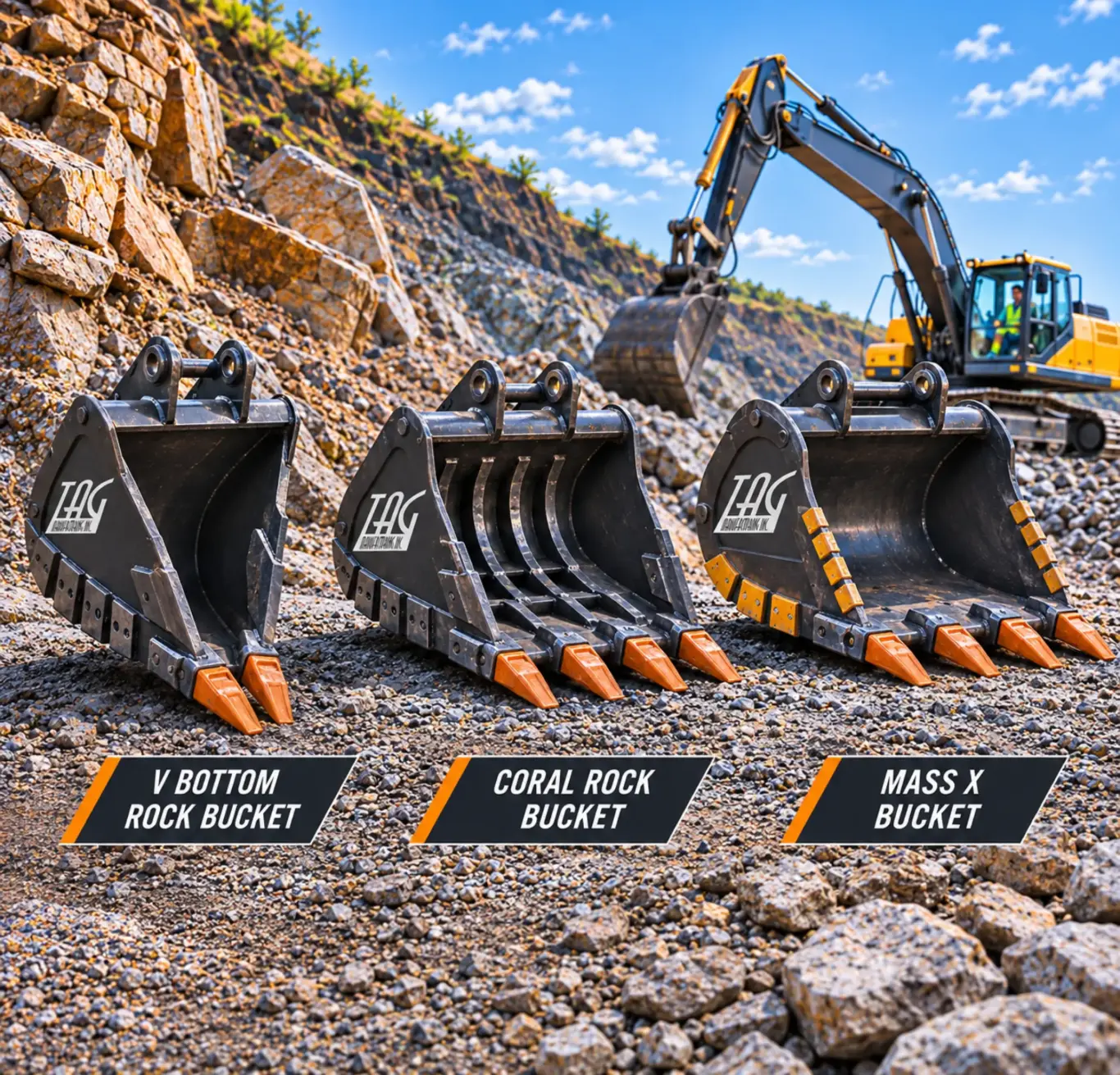
Broken teeth, a bucket that skates across the surface, and a machine that hauls a heavy bucket through every load are three different rock problems with three different fixes.
The right rock bucket for an excavator depends on what the rock is doing to your bucket. Use a V Bottom Rock Bucket to get teeth into hard ground, a Coral Rock Bucket to peel layered coral rock, and the Mass X to move loose material fast.
This post compares the three buckets and explains why rock wears out a standard bucket too fast. It also shows when a digging bucket in a higher duty class, or a ripper, is the better call. For duty classes and bucket types across our whole line, start with our excavator bucket guide.
Which Rock Bucket Do You Need? Match the Bucket to the Problem, Not the Material
Pick the bucket by the failure you see in the cut, because one cut can present more than one problem. Frozen clay in the first foot is a penetration problem. Below the frost line, the same clay is a digging problem. Once it’s loose beside the trench, it’s a loading problem.
Ask what the bucket is struggling to do right now, and use these rules:
- If the teeth won’t go in, use a V Bottom Rock Bucket.
- If the rock comes off in thin layers and wears out your side plates, use a Coral Rock Bucket.
- If the material is loose and you need more yardage per cycle, use the Mass X.
- If the ground is abrasive but the bucket goes in fine, use a Severe Duty digging bucket. For mining and extreme wear, use SXD (Severe Xtreme Duty), part of our Xtreme Duty line.
- If nothing penetrates, even with rock teeth, use a ripper first and a bucket second.
Why Does Rock Wear Out a Standard Bucket So Fast?
Rock wears out a standard bucket fast because it attacks in four ways at once: impact, abrasion, tooth loading, and prying. A standard digging bucket is built for soil, where the main stress is steady abrasion on the underside and the cutting edge. The United Rentals bucket guide warns that running a light bucket in heavy work can tear the cutting edge right off.
Impact. Impact is the damage operators feel. Every time a tooth hits a boulder or a ledge, the shock travels through the adapter, the cutting edge, and the ears into the excavator’s arm. Welds crack first where that load concentrates.
Abrasion. Abrasion is harder to notice until the damage is done. Broken rock is sharp, and the bucket drags across it on every bite and every dump. On a Severe Duty bucket, replaceable wear strips and full side wear plates take that wear instead of the shell. Our post on bucket duty classes explains how Heavy Duty, Severe Duty, and SXD handle it.
Tooth loading. Tooth loading decides whether you penetrate at all. As United Rentals points out, breakout force comes from the machine’s hydraulics, not from the size of the bucket. A straight cutting edge spreads that force across every tooth at once. In hard material, that can be the difference between biting and bouncing.
Prying. Prying bends buckets. Rock work tempts operators to hook a ledge with the corner teeth and curl the bucket, which loads one side and twists the shell. That side load bends the bucket ears, and the extra pin movement wears the bores oval. A bucket built for rock needs the structure to take an off-center load without the side cutter folding.
How Abrasive Is Your Rock? Check the Quartz
Quartz content is a good quick guide to how abrasive your rock is. Quartz is far harder than the calcite in limestone, at 7 on the Mohs hardness scale against 3 for calcite. That’s why the same bucket can wear slowly on a limestone site and too fast on a granite site.
The UK Health and Safety Executive (HSE) publishes the approximate crystalline silica content of common rock and building materials. Crystalline silica in rock is mostly quartz, so the table works as a rough guide to abrasiveness.
| Material | Approximate crystalline silica content (HSE) |
|---|---|
| Sandstone, gritstone, and quartzite | Above 70% |
| Shale | 40 to 60% |
| Mortar and concrete | 25 to 70% |
| Granite | 20 to 45% (typically 30%) |
| Slate | 20 to 40% |
| Basalt and dolerite | Up to 5% |
| Limestone and chalk | Up to 5% (typically under 2%) |
These are industry-general figures, not TAG specifications.
Our duty classes step up with abrasiveness. Heavy Duty is our bucket for general excavation, utility work, and site prep. Severe Duty is built for mini and compact excavators in rock, concrete rubble, and compacted clay. SXD is built for mining and extreme wear applications.
Limestone, slag, and ore depend on the job and the machine, so call us for a recommendation on those. [TAG to confirm: duty class for limestone quarry work, slag, and ore]
What Does a V Bottom Rock Bucket Do Differently?
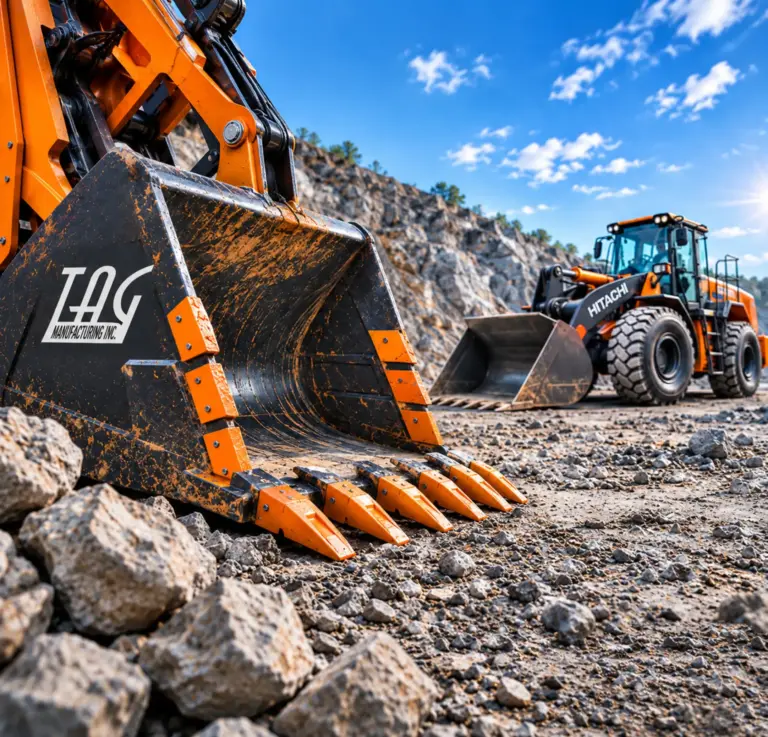
The V Bottom Rock Bucket concentrates the machine’s breakout force on a few teeth at the moment of entry, while a flat cutting edge spreads it across all of them. Its V-shaped cutting edge, fitted with specialty rock teeth, puts the center teeth into the ground first. We build it for hard-packed, rocky, and frozen ground, where a flat cutting edge tends to skate.
Picture a flat cutting edge in frozen ground. All the teeth touch at the same instant, so the machine has to break the crust across the full width of the bucket at once. When it can’t, the teeth slide forward and polish the surface. The operator curls harder and pries, which stresses the bucket and still doesn’t dig.
With a V-shaped cutting edge, the leading teeth take the first bite on their own. The crust fractures there, and the crack runs outward as the rest of the cutting edge follows. The machine does the same work in sequence instead of all at once.
The V Bottom Rock Bucket comes with specialty rock teeth instead of general-purpose teeth. If your yard standardizes on one tooth family, ask us which tooth system and adapters the bucket uses before you order. [TAG to confirm: tooth system and adapter style on the V Bottom Rock Bucket]
Where the V Bottom Rock Bucket Fits
The V Bottom Rock Bucket fits jobs where penetration is the bottleneck. That includes ground packed hard by traffic or time, rocky ground where the bucket works between cobbles, and frozen ground during winter trenching. We build it for excavators and rubber-tire backhoes, which makes it a practical winter bucket for utility crews that run both. If your teeth keep sliding across the cut and the machine isn’t undersized, the problem is the cutting edge, not the operator.
Where It Doesn’t Fit
The V Bottom Rock Bucket doesn’t fit finish grading or soft soil. The V cuts a trench floor that’s deepest in the center, so you’ll spend more time cleaning up than you save cutting. In soft soil, a flat-edge digging bucket fills better, holds more, and cycles faster.
It also isn’t a wear bucket the way a Severe Duty bucket is. Its job is penetration, so if your ground digs easily but wears steel, a higher duty class is the better fix. [TAG to confirm: side plate and wear strip configuration on the V Bottom Rock Bucket, so dealers can position it against Severe Duty]
What Is a Coral Rock Bucket, and What Does “Peeling” Mean?
The Coral Rock Bucket is a Severe Duty bucket designed for peeling coral rock, which means lifting the rock off in thin layers instead of forcing full-depth bites. It carries additional teeth for increased penetration, weld-on replaceable wings for wear protection and peeling, and full side wear pads. We build it for excavators and rubber-tire backhoes.
Coral rock is limestone built by ancient reefs. The Florida Geological Survey describes the Key Largo Limestone as a fossil coral reef from the late Pleistocene. It’s a white to light gray, moderately hard limestone made of coral heads set in a matrix of sand-sized grains.
That makes coral rock a different problem from granite. It’s low in quartz, as the HSE table above shows, so abrasion isn’t its main threat. What makes it hard on a bucket is the way it comes up.
In practice, the operator gets the teeth under a layer and lifts it off, much like lifting sheets of plywood off a stack. Working a layer at a time keeps the machine moving instead of stalling against a full-depth bite.
That changes what the bucket needs. A few large teeth punch holes in the layer instead of lifting it. More teeth across the cutting edge get under the layer at several points and bring it up whole, which is why the Coral Rock Bucket carries additional teeth.
The wings are the second piece. Because the rock peels sideways as well as forward, the sides of the bucket do real work. The weld-on wings protect the sides and help the peeling action, so when they wear, you replace a wing instead of the shell. The full side wear pads do the same job lower down, where the sides drag through broken material on every pass.
Where Coral Rock Buckets Are Used
Coral Rock Buckets are used in coral rock and porous coastal limestone. South Florida and the Florida Keys are the best-known US examples. Any ground where rock comes up in sheets instead of chunks is a candidate. That’s especially true if your crews keep wearing through the side plates of standard buckets in layered rock. [TAG to confirm: regions or dealer territories where the Coral Rock Bucket is stocked]
The Coral Rock Bucket doesn’t belong in hard, blocky rock. If the material fractures into cobbles instead of peeling, the extra teeth spread breakout force over more points, which is the opposite of what penetration needs. That’s a job for the V Bottom Rock Bucket or a ripper.
What Is the Mass X Bucket, and When Does Capacity Matter More Than Wear?
The Mass X Bucket, also called our Hi Cap Flat Bottom Bucket, is a high-capacity excavator bucket with a lighter total weight. Capacity matters more than wear once the rock is already broken and the job is moving it. The Mass X uses AR450 plate in key areas for wear resistance and an extended cutting edge for a deeper profile. It saves weight with a single bottom shell protected by wear straps.
On mass excavation or truck loading, the number that matters is yards per hour. That depends on how much the bucket carries per cycle and how fast the machine swings it.
Every pound of bucket is a pound the machine lifts, swings, and sets down on every cycle. A heavy double-shell digging bucket is the right call when you’re fighting the ground. It’s the wrong call when the ground is already broken and you’re only loading. The Mass X trades some of that structure for capacity and speed. [TAG to confirm: typical heaped capacity and weight by machine class for the Mass X]
What “AR450 in Key Areas” Means
AR450 is abrasion-resistant steel plate in the 450 Brinell hardness class. AR grades are named for their approximate Brinell hardness, so AR450 sits between the more common AR400 and AR500. Harder plate resists wear better, but it gives up some impact toughness, weldability, and formability. These are industry-general figures, not TAG specifications.
That trade-off is why we put AR450 in the key wear areas of the Mass X instead of using it everywhere. The parts that drag through broken material get the harder plate, and the rest of the shell stays easier to form and weld. [TAG to confirm: which Mass X components use AR450 and plate thickness]
The Extended Cutting Edge and the Single Bottom Shell
The extended cutting edge gives the Mass X a deeper profile. In loose material, a deeper bucket heaps higher and holds more before it spills, which is where the extra capacity comes from.
The single bottom shell with wear straps is the weight-saving piece. Our Heavy Duty buckets use a double bottom shell, so abrasion on the outer shell doesn’t breach the structural inner shell. The Mass X uses one shell and lets the wear straps take the abrasion on the underside.
On our standard tooth buckets, the side cutter extends below the cutting edge and helps cut the trench wall. On the Mass X, it doesn’t, so nothing hangs below the cutting edge as you scoop. You give up a little wall-cutting ability and get a bucket that loads and dumps cleanly.
How Do You Estimate What a Bucket Actually Carries in Rock?
Multiply the bucket’s heaped rating by a fill factor, and expect that fill factor to fall well under 100 percent in rock. Bucket capacity is rated as struck or heaped under SAE J296, the standard that defines volume ratings for excavator, mini excavator, and backhoe buckets.
Fill factor is the share of the heaped capacity the bucket actually carries. It depends on penetration, breakout force, rack-back angle (how far the bucket curls back toward the machine), bucket profile, and the teeth on the cutting edge. Moist loam heaps well. Blocky rock that hasn’t been broken small doesn’t.
Here’s an illustration with assumed numbers. Say a bucket is rated at 0.5 cubic yards heaped. At an 80 percent fill factor, each bite brings up 0.4 cubic yards. If blocky rock drops the fill factor to 60 percent, the same bucket brings up 0.3 cubic yards, and you need a third more cycles to move the same pile. These numbers aren’t a rating for any TAG bucket.
That’s why the Mass X’s deeper profile only pays off when the material is broken small enough to heap. In big, blocky rock, a high-capacity bucket carries a lot of air.
Rock is also heavier per yard than soil, so run United Rentals’ quick lift check before you size up. Multiply the bucket’s capacity by the density of the heaviest material you’ll lift, add the attachment weight, and divide by the machine’s adjusted lift capacity. A result under 1.0 means the bucket will work, and a result over 1.0 means you need a smaller bucket or a bigger machine.
Two details matter. First, check whether your machine’s lift chart already includes the bucket’s weight. United Rentals notes that it may or may not, and if it does, don’t count the bucket twice.
Second, use the full attachment weight, including the coupler and teeth, and take lift capacity from the chart at the reach and height where you’ll actually work. United Rentals also warns that a full, heavy bucket at full reach can tip the machine. [Engineering review required]
When Is the Right Answer a Severe Duty or SXD Bucket, or a Ripper?
If the ground is abrasive but your digging bucket goes in fine, you have a wear problem, and a Severe Duty or SXD digging bucket is the better buy. If the ground is solid rock that no tooth configuration will enter, you have a breaking problem, and a ripper has to go in before any bucket does. To tell which one you have, watch the first ten bites of the day.
The bucket goes in and fills, but the teeth and side plates wear too fast. That’s abrasion, and our Severe Duty Bucket is built for it. It carries larger internal triangle reinforcements, full-width replaceable transverse wear strips, extended bucket ears, and full side wear plates. Our design goal is for the wear parts to take the wear instead of the frame behind them.
The wear is the same kind, but heavier and faster, as in mining or other extreme wear applications. That’s where the SXD Bucket comes in. The SXD Bucket has every feature of the Severe Duty line, plus torque tubes, replaceable vertical shrouds, replaceable heel protectors, and a thicker shell and cutting edge. The torque tubes resist the prying loads described earlier, and the heel protectors cover the heel, the part of a rock bucket that drags on every dump. [TAG to confirm: recommended duty class for 10 to 25 ton excavators in rock, and the machine classes the SXD Bucket is built for]
The bucket won’t go in at all. The teeth skate, the machine lifts its tracks, and the operator pries without fracturing anything. That’s solid rock, and it’s ripper work. A single-shank ripper puts the machine’s full breakout force on one point, which takes the logic of the V-shaped cutting edge to its limit. Our guide to excavator rippers covers shank styles and when a ripper beats rock teeth.
On hard rock, a common sequence is a ripper to break the ground and a Mass X to move it. Run the lift check first if the broken rock is dense.
Which Wear Parts Should You Watch on a Rock Bucket?
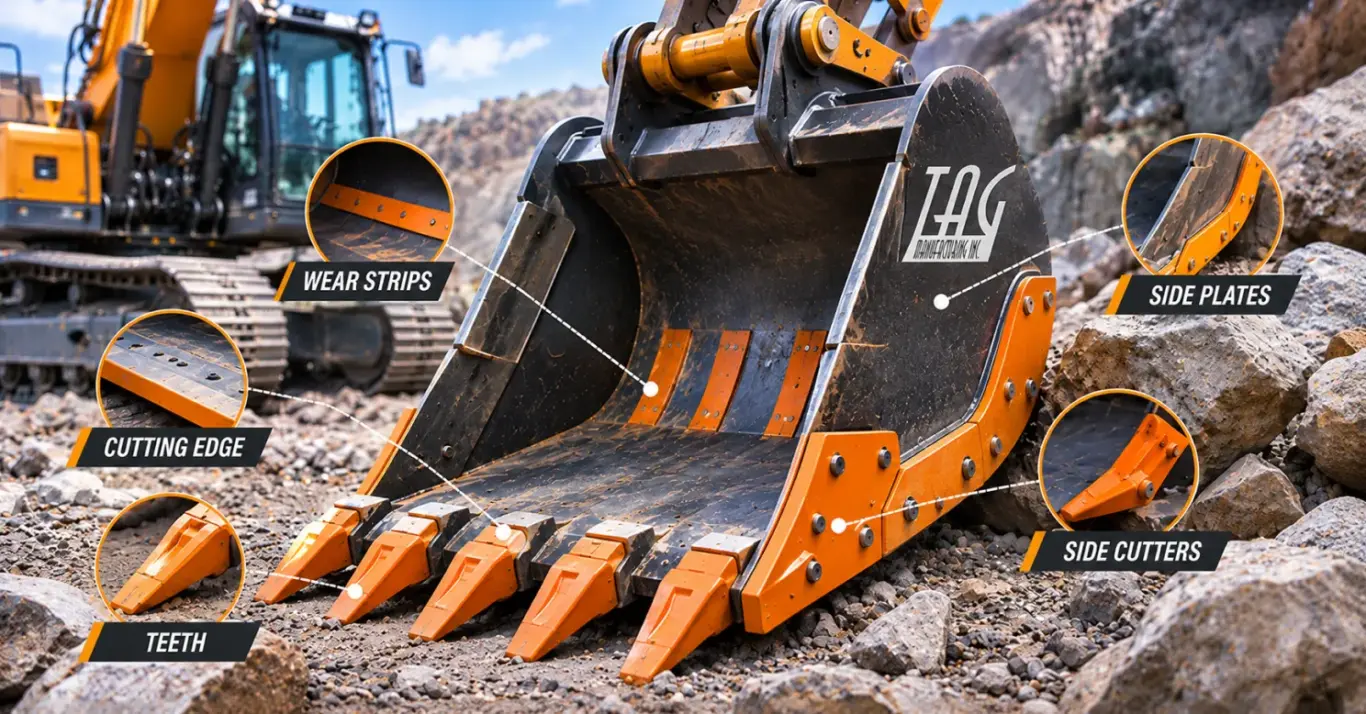
Watch the teeth, cutting edge, side cutters, wear strips, and side plates, because they’re meant to be sacrificial. Rock wears them faster than soil does, and replacing them on time keeps the shell, ears, and adapters behind them protected. On a Coral Rock Bucket, add the wings to that list. On an SXD Bucket, add the vertical shrouds and heel protectors.
Teeth. Replace the teeth before the wear reaches the adapter. Once the adapter is exposed, rock wears it down too, and a tooth change becomes a cut-and-weld job.
Cutting edge. Replace the cutting edge before the second side rounds over. A rounded cutting edge skates on rock, and operators make up for it by prying.
Wings, side plates, and wear strips. Replace them while there’s still steel between the wear and the shell. [TAG to confirm: TAG’s recommended replacement points for teeth, cutting edge, side cutters, and shell wear]
Cracks. Don’t patch-weld over a crack. A crack keeps spreading under a patch weld, and the cause stays hidden. Have it repaired with proper weld preparation, and fix whatever caused it.
Most of the damage on a rock job comes from impact and overload, not abrasion. The habits behind it are side loading, prying, digging with a worn cutting edge, using the bucket as a hammer, and overloading. For a part-by-part look at how wear happens, see why excavator buckets wear out.
Normal wear isn’t a defect. Teeth, cutting edges, side cutters, wear strips, and side plates are wear parts, so they aren’t warranty items. Full terms are on our warranty page, and the TAG Customer Success Team can answer coverage questions through our contact page.
Comparison: V Bottom Rock vs Coral Rock vs Mass X vs SXD
| V Bottom Rock Bucket | Coral Rock Bucket | Mass X Bucket (Hi Cap Flat Bottom) | SXD Bucket | |
|---|---|---|---|---|
| Problem it solves | Teeth won’t penetrate hard-packed, rocky, or frozen ground. | Rock peels in thin layers and wears out side plates. | Moving loose material fast with less bucket weight per cycle | Extreme abrasion and prying loads on a digging bucket |
| Cutting edge and teeth | V-shaped cutting edge with specialty rock teeth | Additional teeth for penetration | Extended cutting edge and deeper profile, with the side cutter above the cutting edge | Thicker cutting edge [TAG to confirm: SXD tooth system] |
| Wear protection | [TAG to confirm: side plate and wear strip configuration] | Weld-on replaceable wings and full side wear pads | AR450 plate in key areas and wear straps on a single bottom shell | Full side wear plates, transverse wear strips, vertical shrouds, and heel protectors, plus torque tubes for prying loads |
| Best jobs | Winter trenching, hard-packed ground, and ground full of cobbles | Coral rock and porous coastal limestone that comes up in layers | Truck loading and mass excavation of loosened or soft material | Mining and extreme wear applications |
| Avoid for | Finish grading, soft soil, and loose loading | Hard, blocky rock and soft soil | Penetration work, frost, and prying | Jobs where a lighter Severe Duty bucket holds up fine |
How to read this table: Find the “Problem it solves” cell that matches what you’re seeing in the cut, and read down that column. If two columns look right, the “Avoid for” row usually breaks the tie. [TAG to confirm: weights by width for the V Bottom Rock, Coral Rock, Mass X, and SXD buckets] [TAG to confirm: whether the Mass X wear straps and the Coral Rock Bucket’s full side wear pads are the same parts as the wear strips and full side wear plates on Severe Duty buckets]
Buy for the Hardest Ground, but Only If You Spend Real Hours in It
Buy a rock bucket for the ground you dig most days, not for the ground you hit now and then. If rock or frost shows up only on the odd job, renting a rock bucket for those jobs usually makes more sense than owning one that sits in the yard. If rock is in the ground you dig every day, buy the bucket built for it. Either way, a quick coupler lets the rock bucket go on for the hard ground and come off when the job changes.
Confirm the bucket fits your machine and coupler before you match it to the rock. Pin diameter, ear spacing, and coupler pattern decide whether the bucket can go on the machine at all. Not every rock bucket comes in every size, so ask about the size range for your machine class when you call. [TAG to confirm: sizes and machine classes available for the V Bottom Rock, Coral Rock, and Mass X buckets]
Guides for This Topic
- Excavator Bucket Guide: Duty Classes, Bucket Types, and How to Choose for Your Ground
- Heavy Duty vs Severe Duty vs SXD: Which Bucket Duty Class Fits Your Ground?
- Why Excavator Buckets Wear Out: Wear Strips, Side Plates, Ears, and Teeth Explained
- Excavator Rippers Compared
Talk to the People Who Build It
Not sure which rock bucket fits your ground? Call (888) 490-0501 or reach the TAG Customer Success Team through our contact page, and we’ll match the bucket to your machine and the rock you’re digging. Every TAG bucket is built in Chattanooga, Tennessee. Before you call, have these ready:
- Your machine’s make, model, and weight class
- Your coupler type
- Your pin size, if you know it
- A plain description of your ground and what the rock is doing to your current bucket
Fast. Rugged. Reliable.
Frequently Asked Questions
What is the difference between a rock bucket and a Heavy Duty bucket?
A Heavy Duty bucket is our digging bucket for general excavation, utility work, and site prep. A rock bucket is built around one rock problem. Our V Bottom Rock Bucket is built for penetration, and our Coral Rock Bucket is built to peel layered rock. If your bucket goes in fine but wears too fast, the better move is a Severe Duty or SXD bucket.
Will a V Bottom Rock Bucket work in frozen ground?
Yes. Frozen ground is one of the jobs we build it for, along with hard-packed and rocky ground. The V-shaped cutting edge puts the center teeth in first, so the machine’s breakout force lands on fewer teeth at the moment of entry. In deep, solid frost, you’ll still need a ripper.
What is a coral rock bucket used for?
A coral rock bucket is used to peel coral rock in thin layers instead of taking full-depth bites. Coral rock is the porous limestone found in places like South Florida and the Florida Keys. Our Coral Rock Bucket carries additional teeth, weld-on replaceable wings, and full side wear pads for that work. It’s the wrong bucket for hard, blocky rock.
What does AR450 mean on the Mass X bucket?
AR450 is abrasion-resistant steel plate in the 450 Brinell hardness class, between AR400 and AR500. Harder plate resists wear better but is harder to form and weld. That’s why we use AR450 in the key wear areas of the Mass X instead of the whole shell. Ask us which components use it on the size you need.
Is a high-capacity bucket safe on a mini excavator?
Only after a lift check. Multiply the bucket’s capacity by the density of your material, add the attachment weight, and divide by the machine’s adjusted lift capacity at your working reach. A result under 1.0 means the bucket will work. Use your machine’s own lift chart, because dense broken rock can overload a compact machine at reach. [Engineering review required]
Should I use a ripper or a rock bucket?
Start with a ripper if the teeth won’t enter the rock with any cutting edge. A ripper puts the machine’s breakout force on one shank and fractures rock that a bucket can’t. If the teeth bite but the bucket stalls or wears too fast, a rock bucket or a higher duty class is the answer.
Can I use a rock bucket for finish grading?
No. The V Bottom Rock Bucket cuts a trench floor that’s deepest in the center, and the Coral Rock Bucket is built for peeling, not smoothing. The Mass X has a flat bottom, but it’s built for capacity, not grade control. For finish work, use a Ditch Cleaning Bucket or a Tilting Ditch Bucket with a smooth bolt-on cutting edge.