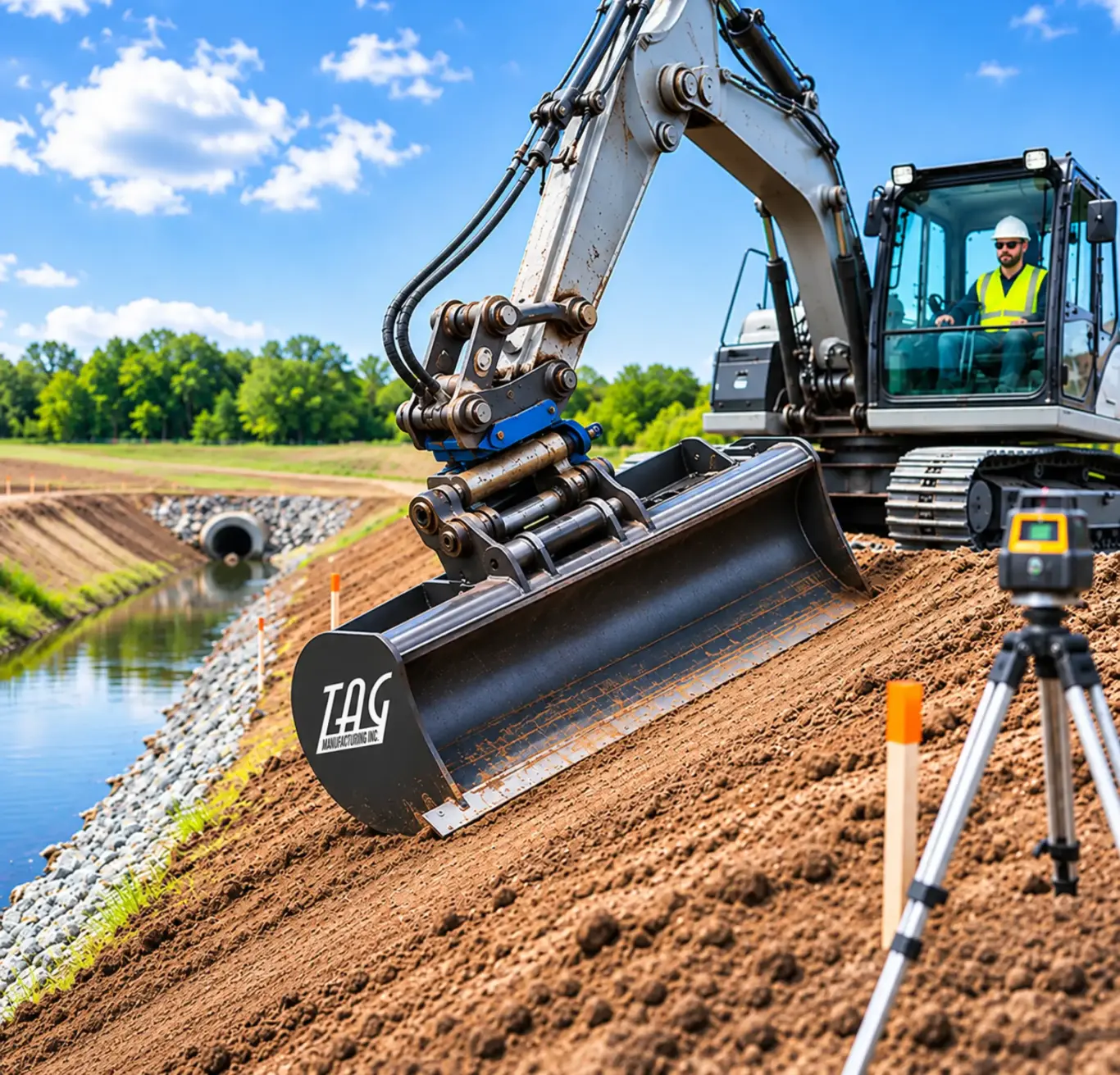
Grading a slope with a fixed bucket usually means moving the machine, checking your line, and moving it again. An excavator tilt bucket for grading slopes cuts out most of those moves. It angles the cutting edge up to 45 degrees left or right, so you can cut a bank, crown a road, or shape a V-ditch from level ground. It beats a fixed ditch cleaning bucket wherever the finished surface isn’t flat, but it costs more and needs an auxiliary hydraulic circuit on the machine.
Below, we explain how our Tilting Ditch Bucket works, which jobs justify one, and when a fixed ditch cleaning bucket, a Powertilt Coupler, a V-bucket, or a shaping blade is the better buy. We also cover width, hydraulic requirements, grading technique, and daily checks. For bucket types and duty classes in general, start with our excavator bucket guide.
What Does a Tilt Bucket Do That a Fixed Ditch Cleaning Bucket Can’t?
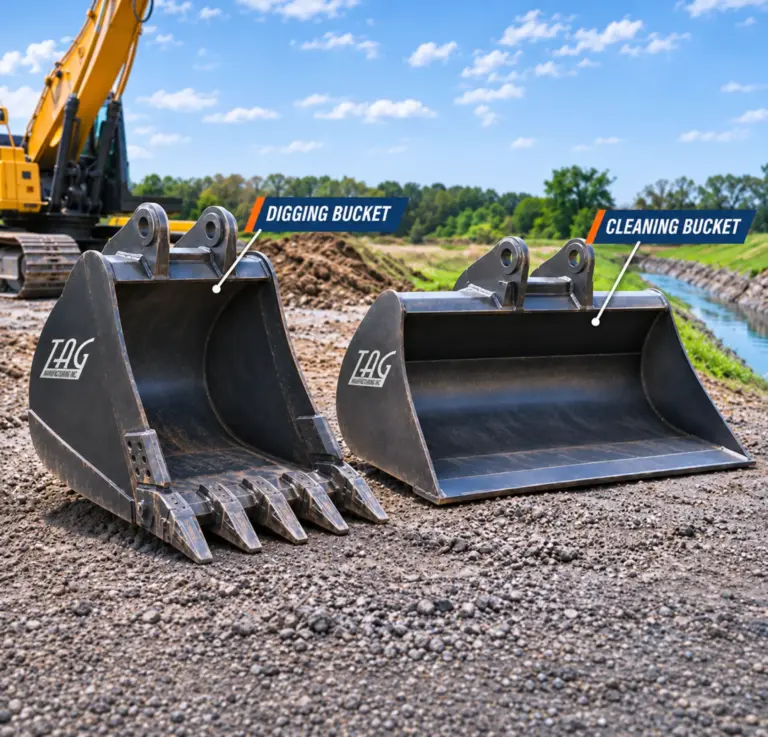
A tilt bucket holds its cutting edge at an angle to the machine while the tracks sit level. That lets you cut, shape, or backfill a sloped surface without moving the machine to line up the bucket. A fixed ditch cleaning bucket keeps its cutting edge parallel to the ground under the tracks. To grade a slope with it, you park on the slope, sit at an angle to the work, or take short passes and rake out the stair steps by hand.
The cost of grading a slope with a fixed bucket shows up as machine moves. Every move costs cycles and a fresh check of your line, and the tracks tear up ground you just finished. Every move you skip also means less wear on your tracks, boom, and hydraulics.
How Does a Tilt Bucket Work?
A tilt bucket is a wide, smooth-edged ditch cleaning bucket with a hinged top section. Hydraulic cylinders between the bucket ears and the bucket body rotate the body side to side around a pivot that runs front to back. The operator runs the tilt from the cab on an auxiliary hydraulic circuit, the same kind of circuit that runs a hydraulic thumb.
The TAG Tilting Ditch Bucket uses a dual-cylinder tilting top and tilts 45 degrees left and 45 degrees right. Below the tilting top, it’s built like our fixed Ditch Cleaning Bucket. It has double bottom bucket shells, smooth and unobstructed openings, internal rib reinforcements on wide widths, and a double radius and dual taper profile. It also carries a double-beveled, reversible bolt-on cutting edge. We build it for excavators and rubber-tire backhoes.
Why 45 Degrees Covers Most Grading Work
Forty-five degrees of tilt each way matches a 1:1 slope, and most slopes on a grading plan are much flatter than that. It’s also the industry-general range for tilt buckets, which United Rentals’ bucket guide gives as up to 45 degrees in both directions for grading and leveling work.
Plans give a slope either as a ratio of horizontal distance to rise or as a percent grade. The table below converts both to the angle you set on the bucket. A bucket that tilts 45 degrees covers every row, with room left over for a machine sitting a few degrees off level.
| Slope ratio (horizontal to rise) | Percent grade | Angle from flat |
|---|---|---|
| 1:1 | 100% | 45° |
| 1.5:1 | 67% | About 34° |
| 2:1 | 50% | About 27° |
| 3:1 | 33% | About 18° |
| 4:1 | 25% | About 14° |
| 6:1 | 17% | About 9.5° |
How to read this table: find the ratio or percent grade on your plans, and set the tilt to the angle in the same row. The angles are plain geometry, not TAG specifications, so they hold for any tilt bucket.
What Dual Cylinders Mean on the Job
Two cylinders let the bucket hold its angle under load. Our tilting top has one cylinder on each side of the pivot, and they push and pull against each other. Cylinder force drives the tilt both ways, instead of one cylinder pushing and the weight of the load bringing the bucket back. When you stop the tilt, both cylinders hold the body between them. [TAG to confirm: cylinder bore on the Tilting Ditch Bucket]
Holding the angle matters most when you’re grading rather than cutting. Grading means dragging the cutting edge along a plane for the machine’s full reach with soil riding on the floor, and then repeating the pass a few inches over. If the angle drifts under load, the surface drifts with it.
What Stays the Same as a Fixed Ditch Cleaning Bucket
Everything below the tilting top does the same job it does on a fixed ditch cleaning bucket. The wide, shallow floor skims the ground instead of digging in. The bolt-on cutting edge takes the wear on its underside, so the floor behind it stays intact. The double bottom shell means wear on the outer skin doesn’t breach the inner structural shell. For more on how the wide bucket works, read ditch cleaning buckets versus digging buckets.
Which Jobs Justify a Tilt Bucket?
A tilt bucket earns its cost on jobs where the finished surface is sloped, where the slope changes along the run, or where the machine can’t sit square to the work. Five jobs come up most often.
Shaping a V-Ditch
A V-ditch is a drainage ditch with two sloped sides that meet at the flow line, the low point where the water runs. With a fixed bucket, you cut each side from a different machine position and then come back to clean up the flow line. With a tilt bucket, you sit on one side, tilt left for the near side, tilt right for the far side, and run the flow line level. The side slopes come out even because you set the angle at the bucket instead of judging it by eye.
Matching a 3:1 Slope
A 3:1 slope rises one foot for every three feet across, which works out to about 18 degrees. It’s a common spec for fill slopes and the sides of stormwater basins, partly because it’s flat enough to mow. Matching it with a fixed bucket on a mini excavator means alternating passes from the bottom and the top of the slope. With a tilt bucket, you set the tilt to 18 degrees, sit at the top of the bank, and pull the bucket up the slope toward you. The floor lies flat on the slope for the whole pass.
Check the slope length against your machine’s reach before you plan the setups. In this illustration with assumed numbers, a basin side drops 6 feet on a 3:1 slope. It runs 18 feet across, so the slope face is about 19 feet long. If your machine reaches about 15 feet at grade (its working range chart gives the real figure), you can’t finish that face in one pull from the top. Plan to shape the upper part from the top and the lower part from the bottom.
Shaping Drainage Channels and Stormwater Basins
Drainage channels and bioretention cells, the planted basins that collect and filter stormwater, are built to a design. Each one has a flat or rounded bottom, set side slopes, and no ruts that would send the water down the wrong path. Many are too narrow to drive into, and tracks would damage the finished surface anyway. A tilt bucket lets the machine sit outside the channel or basin and shape both sides without tracking across the bottom.
Cleaning a Ditch on a Cross-Slope
Roadside ditches along a hillside rarely sit on level ground. The machine sits on a cross-slope, where the ground tilts sideways under the tracks. The ditch bottom still has to stay at grade. With a fixed bucket, the machine’s lean carries through to the cutting edge, and one side cuts deeper than the other. With a tilt bucket, you tilt against the lean and leave the machine where it is.
Backfilling Along a Crowned Road
A crowned road is higher in the middle so water runs off to the sides, and the shoulders fall away from the pavement edge. When you backfill a utility trench along a shoulder or rebuild a shoulder after a culvert replacement, the fill has to match that fall. Otherwise, water ponds against the pavement. Tilting the bucket to the shoulder slope lets you place, drag, and smooth the fill in one motion from the road.
A Simple Decision Rule
Ask three questions about the work:
- Is the finished surface sloped?
- Does the slope change along the run?
- Can the machine sit square to the work?
If the answers are no, no, and yes, a fixed ditch cleaning bucket will do the job. Any other combination means a tilt bucket will save you moves on that job. How often those jobs come up decides whether to rent or own. If it’s a few times a year, rent one. If it’s most weeks, own one.
When Is a Fixed Ditch Cleaning Bucket Enough?
A fixed ditch cleaning bucket is enough when the grade is flat or close to it, the site is open enough to sit the machine square to the work, and budget matters more than the time you’d save on the occasional slope. That covers a lot of work, including flat building pads, level backfill, culvert cleanout, and spreading topsoil.
The TAG Ditch Cleaning Bucket uses a wide, shallow profile to grade and clean out ditches, culverts, and drainage channels in one pass instead of several bites with a digging bucket. We build it for excavators from mini to full size. It has no cylinders, hoses, or valves. There’s nothing to leak, nothing to route around the coupler, and no auxiliary circuit to tie up.
The fixed bucket also wins on simplicity in a rental fleet. It pins onto any machine with the right pin size and goes to work. A tilt bucket needs a free auxiliary circuit and an operator who knows how to run it. For most rental yards, a fixed ditch cleaning bucket for every machine and a tilt bucket on request is a sensible split.
The fixed bucket is also lighter, because it has no tilting top or cylinders. On a 1- to 3-ton machine, a tilt bucket’s extra weight comes out of what the machine can lift and how far out it can carry a load. [TAG to confirm: weight difference between the Tilting Ditch Bucket and the fixed Ditch Cleaning Bucket at a comparable width]
When Is a Powertilt Coupler the Better Buy?
A Powertilt Coupler is the better buy when you want tilt on every attachment instead of on one bucket. The tilt is built into the coupler, so your digging bucket, ditch cleaning bucket, rake, and ripper all get it, and you pay for the tilt hydraulics once.
The TAG Powertilt Coupler is a tilting coupler for any attachment that can be pinned to a machine. It uses Parker/Helac next-generation actuators and gives up to 180 degrees of attachment rotation, compared with 45 degrees each way on the Tilting Ditch Bucket. It comes in hydraulic multi-lock pin grabbing, mechanical half-hitch pin grabbing, TAG QC series, Deere and Hitachi wedge, and Kubota wedge styles. That means the tilt can sit under whatever interface your fleet runs.
The coupler fits better in three cases. The first is a crew that grades with several attachments that would all benefit from angle. The second is work that needs more than 45 degrees, such as rolling a bucket to clean a vertical face. The third is a machine that’s already getting a new coupler, where choosing the tilting version adds tilt without a separate tilt bucket.
Two cases point back to the tilt bucket. If one ditch cleaning bucket does most of the machine’s sloped work and the rest is plain digging, putting the tilt in that bucket costs less than putting it in the coupler. If the machine has no coupler and you don’t want one, a tilt bucket that pins straight to the machine is the simplest way to get tilt. Either way, pick one place for the tilt to live, because a tilt bucket under a tilting coupler adds weight for no benefit. We go deeper in tilting couplers: Powertilt versus swapping buckets.
When Is a V-Bucket or Shaping Blade Cheaper?
A V-bucket costs less than a tilt bucket when the only sloped surface you need is the inside of a trench. A shaping blade costs less when the job is finish grading on open ground and you need width more than angle.
A V-bucket is a bucket with fixed, angled sides and no tilt hydraulics. Because the sides are fixed, every trench gets the same profile. That’s a limit on a mixed job, but it’s an advantage on a pipe job where every trench needs the same shape.
A shaping blade is a wide, flat edge that pins on in place of a bucket. It doesn’t carry material, so pair it with a fixed ditch cleaning bucket for loading. On a large, flat building pad, it covers more ground per pass than any bucket. On a slope, though, its edge stays parallel to the ground under the tracks, just like a fixed bucket’s edge. We compare the two for flat work in finish grading with a shaping blade or a tilt bucket.
How Wide Should a Tilt Bucket Be?
Stay within the width your machine’s manufacturer recommends. A tilt bucket is a grading bucket, so the widths that apply are grading and ditching widths, which run much wider than a digging bucket on the same machine. United Rentals treats grading and ditching buckets as the same bucket, and its bucket guide lists recommended grading widths by machine size.
| Machine size | Recommended grading or ditching bucket width (United Rentals) | Standard digging bucket on rental machines (Sunbelt Rentals) |
|---|---|---|
| 1 to 1.9 tons | 36 in | 12 in |
| 2 to 3.5 tons | 36 in | 12 to 24 in |
| 4 tons | 36 to 48 in | 24 in |
| 5 to 6 tons | 36 to 48 in | 24 in |
| 7 to 10 tons | 48 to 60 in | 24 in |
| 10 to 15 tons | Not listed | 36 in |
| 15 to 25 tons | 60 in | 36 to 48 in |
How to read this table: find your machine’s operating weight and read across. The middle column is United Rentals’ recommended grading width. For comparison, the right column is the standard digging bucket on Sunbelt Rentals’ mini excavators and larger excavators. These are industry-general figures, not TAG specifications. [TAG to confirm: Tilting Ditch Bucket widths and machine-class range, including the 10 to 15 ton class]
Width and weight work together on a tilt bucket. The wider the bucket and the heavier the tilting top, the more of the machine’s lift capacity the bucket uses before it carries any soil.
United Rentals’ guide gives a lift check for this. Multiply the bucket’s capacity in cubic yards by the density of the heaviest material you’ll carry, and add the attachment weight. Divide that total by the machine’s lift capacity from its lift chart, adjusted as the guide explains for whether the chart already counts a bucket. If the result is higher than 1, the bucket is too heavy for the machine. On a mini excavator, run that check with the tilt bucket’s full weight before you order the widest size. [Engineering review required]
Tilt Bucket Hydraulic Requirements: What the Machine Needs
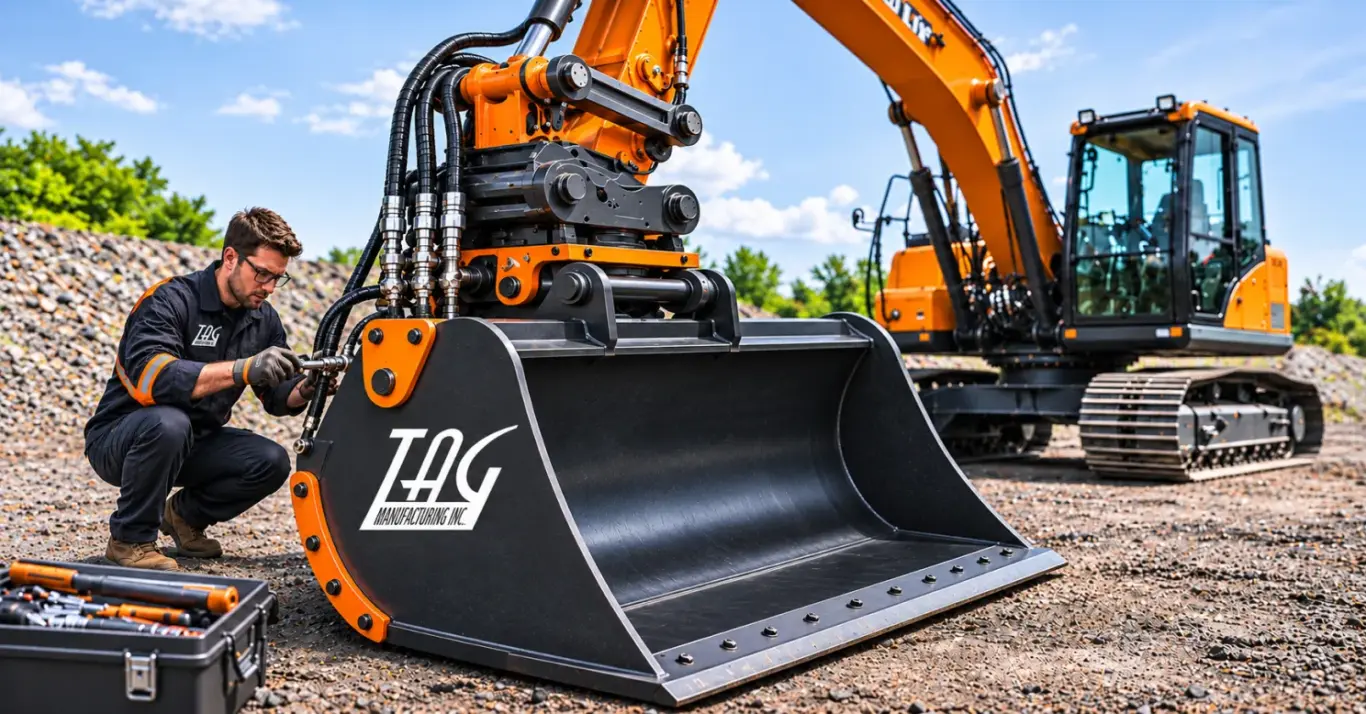
A tilt bucket needs a double-acting auxiliary hydraulic circuit plumbed to the end of the arm, with cab controls that let the operator tilt both ways and hold position. Double-acting means the circuit sends oil to both ends of the cylinders, so it can drive the tilt left and right.
- Auxiliary circuit. Many mini and compact excavators have an auxiliary circuit for a thumb or hammer. Confirm that a proportional, double-acting circuit is free for the tilt. If a hydraulic thumb already uses the only auxiliary circuit, you’ll need a second circuit or a diverter valve, which switches one circuit between two tools.
- Flow and pressure. Tilt cylinders are small next to a hammer. Too much flow makes the tilt jumpy, and too little makes it slow under load. Compare the bucket’s figures with the machine’s auxiliary output. [TAG to confirm: flow and pressure requirements for the Tilting Ditch Bucket] [Engineering review required]
- Hose length and fittings. Order hoses long enough to reach with the bucket fully curled in and fully dumped out, at full tilt each way, without stretching or pinching. Confirm that the quick-connect fittings match the machine.
- Load-holding valves. A loaded tilt bucket should hold its angle when you release the control. Confirm whether the bucket carries load-holding valves at the cylinders or the machine’s circuit does that job. [TAG to confirm: whether load-holding or counterbalance valves are standard on the Tilting Ditch Bucket] [Engineering review required]
- Coupler compatibility. If you run a quick coupler, confirm that the pin diameter, ear spacing, and pin center-to-center distance match the coupler’s pattern. Also confirm that the coupler leaves the hoses room to move. [TAG to confirm: pin and ear dimensions by machine class]
- Cab controls. The tilt should run from a proportional thumbwheel or slider, where the tilt speed follows how far you move the control, not from an on-off button. Being able to feather the tilt, which means moving it in small, smooth amounts, is the whole point.
- Case drain. Some hydraulic actuators need a case drain, a low-pressure line that returns internal leakage to the tank, but simple cylinders usually don’t. Check the spec before you order hoses. [Engineering review required]
Grading a Slope With an Excavator and a Tilt Bucket
The tilt sets the angle, and the boom and arm carry the cutting edge along it.
Set the angle before the pass. Tilt to the slope you want, and check it against a grade stake or string line. Run the pass with the boom and arm only. Chasing the angle under load leaves a wavy surface, so correct the tilt between passes, not during them.
Keep the tracks level. Sit the machine as level as the ground allows, and let the tilt make up the difference between the machine and the slope. Leaning the machine to help the bucket throws away your reference.
Pull, don’t push. Draw the bucket toward the machine with the cutting edge skimming at the angle you set. Pushing a wide bucket away from you on a slope puts the load out at the end of the arm and can lift the front of the tracks. Pulling keeps the weight on the machine and the surface in view.
Work bottom up on fill and top down on cut. On a fill slope, start at the bottom so each layer of fill builds against compacted ground. On a cut slope, start at the top so loose material falls where you can load it out.
Overlap passes by a third of the bucket width. Overlap hides the ridge each pass leaves at its edge. It also lets part of the floor ride on finished ground, which steadies the cut.
Use the tilt to dump sideways. When you carry material out of a drainage ditch, tilt to one side on the way out and drop the material in a row along the edge without swinging the machine.
Check the surface from the side. Have a spotter stand well outside the machine’s swing area and sight along the slope from the end of the run. A surface that looks good from the cab can show ridges from the side. Fix those ridges with more overlap, not more tilt.
Daily Checks and Wear Parts on a Tilt Bucket
A tilt bucket needs the same wear checks as a fixed ditch cleaning bucket, plus a few minutes on the tilt hardware before each shift.
Cutting edge. Flip the reversible edge when one bevel rounds over, and replace it before the second bevel rounds over. A worn edge skips across the ground instead of cutting, and it lets wear reach the floor behind it. The cutting edge is a wear part. Normal wear on it isn’t a defect, and it isn’t a warranty item.
Hoses and fittings. With the machine parked, run the bucket through full tilt each way, both fully curled in and fully dumped out. Watch for any hose that binds or rubs on the coupler, the arm, or the bucket ears. A hose that rubs will wear through, and it’s easy to reroute before that happens.
Cylinders. Look for oil on the cylinder rods and around the seals. If a loaded bucket creeps off its angle when you release the control, find out why before you keep grading. [Engineering review required]
Pivot and pins. Check the tilt pivot and the cylinder pins for play. Pin movement wears the bores oval, and play at the pivot shows up as a cutting edge that won’t hold a clean line. [TAG to confirm: grease points and greasing interval for the tilt pivot and cylinder pins]
Bucket ears and welds. Side load and impact bend bucket ears, so don’t use a tilted bucket to shove material sideways or pry. If you find a crack, don’t cover it with a patch weld. Cracks keep spreading under a patch weld, and the cause stays hidden. Have it repaired with proper weld preparation, and fix whatever caused it.
If you think a cylinder, weld, or other part has a defect, call our Customer Success Team before any repair is made. Our warranty process asks for written approval before repairs, along with photos of the problem.
Guides for This Topic
- Excavator Bucket Guide: Duty Classes, Bucket Types, and How to Choose for Your Ground
- Ditch Cleaning Bucket vs Digging Bucket: When a Wide, Smooth-Lip Bucket Pays Off
- Tilting Couplers Explained: When a Powertilt Beats Swapping Buckets
Talk to the People Who Build It
Not sure whether a tilt bucket, a fixed ditch cleaning bucket, or a Powertilt Coupler fits your work? Call (888) 490-0501 or reach the TAG Customer Success Team through our contact page, and we’ll help you match the setup to your machine. Before you call, have these ready:
- Your machine’s make, model, and weight class
- Your coupler type
- Your pin size, if you know it
- Which auxiliary circuits are free on the machine
- A plain description of your ground and the slopes you work
Every TAG bucket is built in Chattanooga, Tennessee.
Fast. Rugged. Reliable.
Frequently Asked Questions
Is a tilt bucket worth it for a mini excavator?
Yes, if the machine regularly grades slopes, ditches, or road shoulders where the finished surface isn’t flat. The tilt lets you match the angle without repositioning, which saves cycles and leaves a cleaner surface. If the machine mostly digs and backfills on level ground, a fixed ditch cleaning bucket costs less, weighs less, and has nothing to leak. Rent a tilt bucket for a week on a slope job before you buy one.
How many degrees does a tilt bucket tilt?
Tilt buckets commonly tilt up to 45 degrees in both directions. Our Tilting Ditch Bucket tilts 45 degrees left and 45 degrees right with a dual-cylinder tilting top. A 1:1 slope is 45 degrees, a 2:1 slope is about 27 degrees, and a 3:1 slope is about 18 degrees. That range covers every common grading slope, with room left over for a machine sitting off level.
What hydraulics does a tilt bucket need?
A tilt bucket needs a double-acting auxiliary hydraulic circuit at the end of the arm, run from proportional cab controls. It’s the same type of circuit used for a hydraulic thumb. The circuit’s flow and pressure must suit the bucket’s cylinders, and the bucket should hold its angle when you release the control. If a thumb already uses the only auxiliary circuit, you’ll need a second circuit or a diverter valve.
Tilt bucket or tilt coupler: which should I buy?
Buy a tilt bucket if one ditch cleaning bucket does most of the machine’s sloped work and the rest is plain digging. Buy a tilting coupler such as our Powertilt if several attachments would benefit from angle, if you need more than 45 degrees of rotation, or if you’re already putting a coupler on the machine. The coupler costs more up front, but it gives tilt to everything that pins to it.
Can I use a tilt bucket for digging?
Don’t use it as your main digging bucket. A tilt bucket is a grading bucket with a wide, shallow floor and a smooth bolt-on cutting edge built for skimming and shaping. The tilting top also adds weight and moving parts that a digging bucket doesn’t have. It will scoop loose material and cut soft ground. For trenching, hard ground, or rock, pin on a digging bucket with teeth.
Does a tilt bucket work with a quick coupler?
Yes, as long as the bucket’s pin diameter, ear spacing, and pin center-to-center distance match the coupler’s pattern. The hoses also need room to move through the full tilt range without rubbing on the coupler. We build the Tilting Ditch Bucket for excavators and rubber-tire backhoes. Tell us the machine make, model, and coupler type when you call, and we’ll help you confirm the fit.k coupler, the operator changes from the digging bucket to the ditching bucket in minutes, and some couplers do it without leaving the cab.