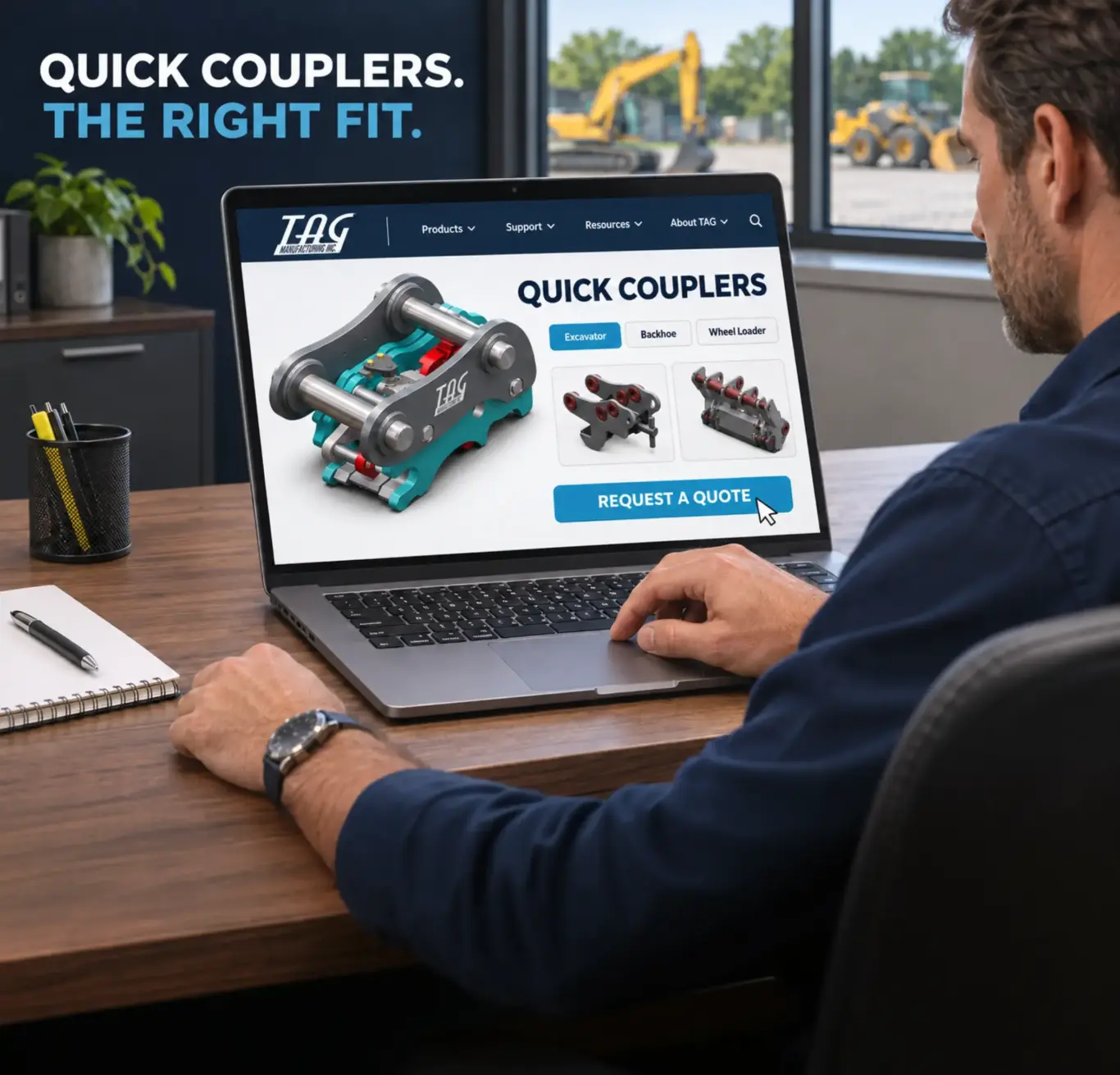
Choosing quick couplers for excavators, backhoes, and wheel loaders comes down to three questions: what machine it goes on, what attachments you already own and whose pattern they follow, and how often you swap and who’s in the seat when you do. Answer those three, and the coupler family mostly picks itself.
A mixed pile of pin-on tools points to a pin-grabber. A matched set of buckets points to a dedicated or wedge coupler. Slope and ditch work points to a tilting coupler. On a loader, you want a coupler built for your attachment pattern, or one that takes several. All 10 of the couplers we build and carry for these machines are on our couplers page.
What Does a Coupler Save, and What Does It Cost?
A coupler saves you from driving pins on every attachment change, and it costs you some breakout force, some weight on the end of the stick, and its purchase price. The coupler, also called a hitch or quick hitch, stays pinned to the stick and grabs the attachment instead. The change goes from a two-person job with a sledgehammer to a few minutes on the ground, or to a switch in the cab.
Breakout force is the first cost. Tip radius runs from the center of the main stick pin to the tips of the bucket teeth. A coupler moves the teeth farther from that pin, and a longer tip radius delivers less breakout force at the teeth [TAG to confirm: added tip radius for each TAG excavator coupler, by model].
Here’s an illustration with assumed numbers, not specs for any machine or coupler. Say your machine is rated at 10,000 lb of bucket breakout force and the coupler costs you 5% of it, which leaves 9,500 lb. In loose fill, nobody will feel the missing 500 lb. At the bottom of a footing in frozen clay, the operator may see the bucket stall a little sooner.
Weight is the second cost. The coupler’s weight comes off what the machine can safely lift, so check it against the machine’s lift chart before you buy [TAG to confirm: weight of each TAG excavator coupler, by model].
Question One: What Machine Is the Coupler Going On?
Start with the machine’s size class and type, because a coupler is built around the pins and the stick it hangs from. Size class narrows down which coupler fits your excavator before anything else does.
Compact and mini excavators, roughly 2 to 8 tons, have the most choices. For that class we build the QC27 model of the TAG QC Coupler, and our Mechanical Pin Grabber Coupler comes in a Spring Latch style for backhoes and compact excavators from 2 to 8 tons.
On full-size machines, the QC30 model takes heavier attachments, and the Mechanical Pin Grabber moves to a Screw & Hitch Slide style for 12 to 20 tons. Our Mechanical Pin Grabber listings don’t cover the 8 to 12 ton range, so call us before you order one for a 10-ton machine [TAG to confirm: Mechanical Pin Grabber coverage for machines between 8 and 12 tons].
The Hydraulic Multi-Lock Coupler covers machines from 2 to 120 tons. That span lets a fleet with compact and full-size excavators run one coupler type across the yard.
Rubber tire backhoes need two decisions, because the hoe end and the loader end each want a coupler. Our excavator couplers are offered for the hoe end, and our loader couplers fit the loader end as well as wheel loaders [TAG to confirm: backhoe models and sizes covered by each coupler].
For a mixed fleet, measure the pins and the stick on each machine yourself. A previous owner may have swapped the stick, and pin movement wears the bores oval, so the spec sheet may not match the machine in front of you. Our guide on how to measure your machine for a coupler covers pin diameter, pin spread, and stick width.
Question Two: What Attachments Do You Already Own, and Whose Pattern Are They?
The attachments you already own usually decide the coupler, because the coupler has to pick up what’s in your yard. Pull every bucket, thumb, rake, and plate compactor into the open and look at the top of each one. Some will have plain pin ears for pinning straight to a stick. Others will carry a coupler interface, such as a John Deere Wedge, a Kubota Quick Attach, a Bobcat X-Change, or a TAG QC.
Pin-on attachments were never standardized. Unlike skid steers, compact excavators have no common mounting system, and pin diameter, pin spread, and ear width all vary by brand and size class. A pin-grabber coupler handles that by accepting a range of pin diameters and spreads [TAG to confirm: pin diameter and pin spread pick-up ranges for the Mechanical Pin Grabber and Hydraulic Multi-Lock, by model]. A dedicated coupler fits one interface closely, and every attachment needs that interface.
Use the pile to decide:
- A yard full of pin-on buckets from three brands leans toward a pin-grabber.
- A yard already committed to one wedge pattern usually stays with it.
- A yard starting from scratch, or one tired of stocking the same bucket four ways, can pick a single interface and buy into it.
OEM Style Quick Coupler Buckets are built for compact excavators running John Deere Wedge, Kubota Quick Attach, or Bobcat X-Change couplers. So if the fleet already runs one of those wedges, the next wedge coupler for a mini excavator should match it, and every bucket keeps fitting every machine. If the buckets themselves are the open question, our excavator bucket guide covers duty classes, bucket types, and how to match a bucket to your ground.
Running the Numbers for a Three-Brand Rental Yard
In a three-brand rental yard, a pin-grabber keeps your current buckets in play, and a dedicated coupler shrinks the shelf. Picture minis from three makers, each needing a 12-inch, an 18-inch, and a 24-inch bucket. With every bucket pinned direct, that’s nine buckets before you add a spare.
Put a pin-grabber on every machine and, as long as the pick-up range covers your pins, the existing buckets can move between brands. Put one dedicated interface on every machine and the shelf drops to three buckets, but you pay to re-equip or replace the ones you have. Lead time counts too, because a pin-grabber that picks up the bucket already in the yard looks cheap when a dedicated bucket is weeks out. The rental version of this decision gets its own post: pin-grabber vs dedicated couplers for rental fleets.
Plan the Thumb with the Coupler
A coupler moves the bucket tip farther from the stick, so plan the thumb at the same time, or the thumb may close short of the bucket tip. Check where the thumb tip meets the bucket tip with the coupler fitted.
The Main Pin Hydraulic Thumb bolts onto the existing coupler pin instead of a bracket welded to the stick, so it stays with the machine through every attachment swap. The geometry is laid out in using a thumb with a quick coupler.
Question Three: How Often Do You Swap, and Who’s in the Seat?
Swap frequency decides whether a hydraulic quick coupler pays for itself, and the person in the seat decides how much a cab-controlled lock is worth. The UK’s Health and Safety Executive (HSE) notes in guidance for its own inspectors that operators may change buckets up to 30 times a day. That’s an industry-general figure from the UK, not a TAG number.
Is a Hydraulic Coupler Worth the Extra Money?
A hydraulic coupler is worth the extra money when the time it saves is worth more than the price difference. Here’s an illustration with assumed numbers, so time your own crew before you trust ours. Say a crew swaps six times a day among a trenching bucket, a grading bucket, and a plate compactor. Assume each change through a mechanical quick coupler takes ten minutes of climbing down, working the latch, and climbing back up, against two minutes from the cab.
- Each swap saves 8 minutes.
- Six swaps save 48 minutes a day.
- A five-day week saves 240 minutes, or four hours.
- Forty working weeks save 160 hours, or 20 eight-hour days of an operator and a machine.
On the other side, a hydraulic coupler costs more than a mechanical one, and it needs a hydraulic circuit to the stick, a control in the cab, and the labor to install them [TAG to confirm: hydraulic kit contents and circuit requirements for TAG excavator couplers].
To find your break-even, take the price difference between the two couplers, including the kit and installation. Divide it by what an hour of operator and machine time costs you. The result is the number of saved hours the hydraulic coupler has to earn back. If your timed swaps reach that number well inside the time you plan to keep the machine, buy hydraulic.
Change the assumptions, and the answer changes too. A machine that wears one trenching bucket all week might swap twice, which saves 16 minutes a week and won’t pay back a hydraulic coupler. That machine is better served by a good mechanical coupler, or by no coupler at all.
Your Own Crew or a Rental Customer?
A rental customer you’ll never meet makes a stronger case for a cab-controlled coupler than your own trained crew does. HSE’s inspector guidance says most of the hitch incidents it deals with involve semi-automatic hitches, where the operator has to climb out after latching to fit a safety pin and doesn’t. Safe Work Australia prefers automatic hitches because the safety device can be engaged and checked from the operator’s seat.
Nobody is there to see whether a renter skipped a step. Where you’ll never meet the operator, choose a coupler run from the seat with a lock the operator can see. The full cost, cycle time, and safety comparison is in mechanical vs hydraulic quick couplers.
The Main Coupler Families
Excavator and backhoe couplers come in three families: pin-grabbers, dedicated or wedge couplers, and tilting couplers. Wheel loader couplers split into single-pattern and multi-pattern designs.
Pin-Grabbers, Mechanical and Hydraulic
A pin-grabber closes a hook and a jaw around the attachment’s own pins, so it can pick up most pin-on tools inside its range, whoever built them. Many designs can also pick up a bucket reversed for front-shovel digging [TAG to confirm: whether the Mechanical Pin Grabber and Hydraulic Multi-Lock pick up buckets reversed]. The price of that range is size, because a pin-grabber usually adds more length and weight to the end of the stick than a coupler built for one interface.
The Mechanical Pin Grabber Coupler is our reliable, economical pin-grabber. With either the Spring Latch or the Screw & Hitch Slide style, someone sets the latch by hand, which is why the operator question matters so much here.
The Hydraulic Multi-Lock Coupler is the Dromone design we carry for excavators and backhoes, and we’re the exclusive North American distributor of Dromone quick couplers. It’s built from high-strength steel, every control is in the cab, and it carries a heavy-duty certified lifting eye [Engineering review required: lifting eye rating and lifting use]. The deep dive is inside the Dromone Multi-Lock.
Dedicated and Wedge-Style Couplers
Dedicated and wedge-style couplers trade pin range for a closer fit. With no range of pins to reach, they’re usually lighter and more compact than a pin-grabber.
The TAG QC Coupler is our dedicated interface, and it started with a rental problem. Gary Wilt, one of our founders, sketched the first QC27 concept on a napkin during a flight from San Diego to Atlanta. He wanted a universal coupler so rental companies could standardize attachments across compact excavator fleets. Takeuchi was the first OEM to adopt the QC27, as part of its offering to national rental companies.
The TAG QC Coupler uses our Adjust-A-Hook design in both models [TAG to confirm: how Adjust-A-Hook takes up pin and hook wear]. Both lock buckets, thumbs, and other attachments on without the operator leaving the cab, and both are built and machined in Chattanooga. The TAG Quick Coupler System is the preferred setup for United Rentals, Sunbelt Rentals, and other national fleets running 2 to 6 ton compact excavators. The longer story is in how the QC27 went from a napkin sketch to a rental standard.
Tilting Couplers
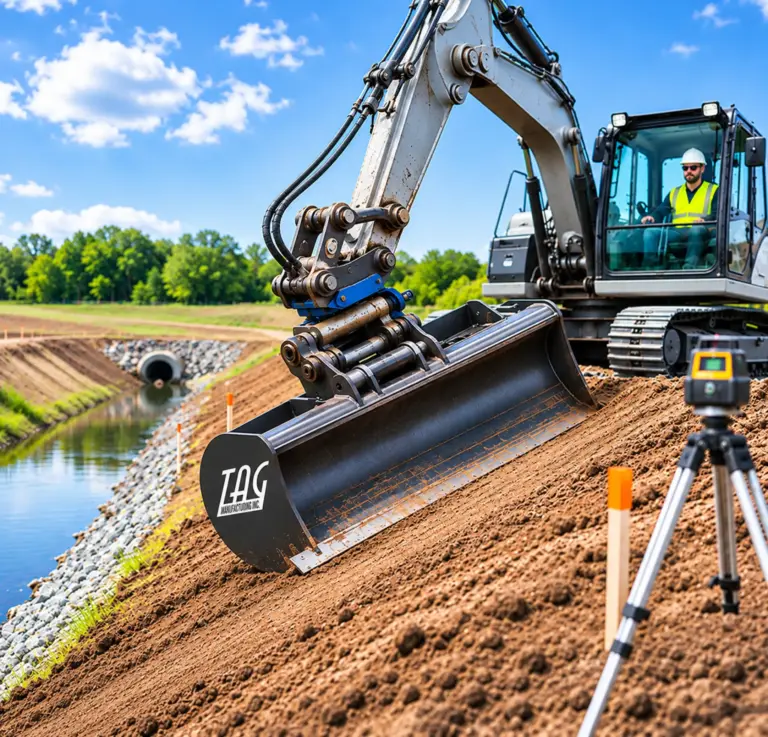
A tilting coupler, often called a tilt coupler, sets the bucket on the machine at a different angle instead of making you swap to a different bucket. Picture shaping the side slope of a drainage ditch with a fixed bucket. Every pass that doesn’t line up means moving the tracks or leaving a stepped face for someone with a rake. Tilt the bucket to the slope, and the machine stays put.
The Powertilt Coupler sits between the stick and the attachment and tilts anything that can be pinned to the machine, with up to 180 degrees of rotation from Parker/Helac next-generation actuators. It comes in hydraulic multi-lock pin-grabbing, mechanical half-hitch pin-grabbing, TAG QC series, Deere/Hitachi wedge, and Kubota wedge styles.
A tilting coupler’s cost is more weight and length on the end of the stick. The Tilting Ditch Bucket puts the tilt in the bucket instead, tilting 45 degrees left and right. If you need tilt on more than one attachment, put it in the coupler. If the tilt work is ditch cleaning and shaping with one bucket, put it in the bucket. Our guide to tilting couplers covers that choice.
Wheel Loader Patterns
A wheel loader quick coupler is built around one or more attachment patterns, and the patterns don’t interchange. The common ones are CAT IT (with a horizontal cylinder), CAT-style vertical twin-cylinder, JRB 416 and 418, John Deere Hi-Vis, and Volvo ISO. Several look alike from 20 feet away. Loader attachments are expensive to rework, so confirm the pattern before you order anything.
If one pattern runs the whole yard, one of our four single-pattern couplers is usually the simplest answer:
- The TAG Series 9 Hyd Coupler takes CAT-style vertical twin-cylinder attachments. It isn’t compatible with CAT-style IT couplers that use a horizontal cylinder.
- The Xtreme Duty Hyd Coupler has a reinforced carriage, standard full debris covers and plating, and a dual-cylinder interface. We recommend it for forestry and recycling, where bark and scrap get into everything.
- The Hydraulic Coupler for wheel loaders is our cab-controlled option for OEM quick coupler configurations, with a single-cylinder, two-pin design.
- The Mechanical Coupler for wheel loaders is the economical option for a loader that wears one bucket all week. It shares the hydraulic model’s carriage design, uses two pins, and fits most OEM quick coupler configurations.
The three hydraulic models each ship with a hydraulic kit. Our wheel loader couplers compared post puts all six of our loader couplers side by side, pattern by pattern.
Multi-Pattern Loader Couplers
A multi-pattern coupler is for the yard where several patterns meet, such as a used Volvo loader with ISO tools, two JRB-pattern buckets, and a set of Hi-Vis forks rented for a month. One multi-pattern coupler on the loader saves reworking those attachments to a single pattern.
The Hydra Multi-QC Coupler interchanges CAT IT, JRB, and Volvo/Hi-Vis attachments in one unit, so it’s the one to look at when CAT IT tools are in the mix. It has a heavy-duty carriage and comes with a hydraulic kit.
The Hydra-II Quick Coupler handles JRB and Volvo/Hi-Vis attachments in two classes. The 200 to 500 Class picks up JRB 416 plus John Deere Hi-Vis or Volvo L50 through L120 ISO attachments. The 600 Class picks up JRB 418 plus the same Hi-Vis and Volvo ISO range.
“Mixed fleets are becoming the norm,” as we put it in our July 2026 Hydra-II write-up. A rental loader wearing a Hydra-II can go out to a contractor with JRB-pattern buckets one week and to a contractor with Volvo ISO tools the next. That week-by-week picture is in Hydra-II on the job.
Which Quick Couplers for Excavators and Loaders Fit Your Job?
Find the row that sounds most like your yard, and the right-hand column names the coupler we’d start with.
| Your situation | Coupler family | TAG product |
|---|---|---|
| Mini or compact excavator (2 to 8 t), mixed pin-on buckets, a few swaps a day | Mechanical pin-grabber | Mechanical Pin Grabber, Spring Latch style |
| Full-size excavator (12 to 20 t), one main bucket, budget comes first | Mechanical pin-grabber | Mechanical Pin Grabber, Screw & Hitch Slide style |
| Any excavator from 2 to 120 t, frequent swaps, mixed pins, cab control wanted | Hydraulic pin-grabber | Hydraulic Multi-Lock (Dromone) |
| Compact fleet across brands standardizing on one bucket interface | Dedicated coupler | TAG QC Coupler, QC27 |
| Full-size excavator running heavier attachments on one interface | Dedicated coupler | TAG QC Coupler, QC30 |
| Slopes, drainage ditches, and finish work around utilities | Tilting coupler | Powertilt Coupler |
| Loader with CAT-style vertical twin-cylinder attachments | Single-pattern hydraulic | TAG Series 9 Hyd Coupler |
| Loader in forestry or recycling | Reinforced hydraulic | Xtreme Duty Hyd Coupler |
| Loader on an OEM pattern, frequent changes | Single-pattern hydraulic | Hydraulic Coupler |
| Loader on an OEM pattern, occasional changes | Mechanical | Mechanical Coupler |
| Loader fleet mixing JRB with Hi-Vis or Volvo ISO tools | Multi-pattern | Hydra-II Quick Coupler |
| Loader fleet that also carries CAT IT attachments | Multi-pattern | Hydra Multi-QC Coupler |
If two rows both sound right, the one with fewer swaps a day usually wins on cost, and the one with strangers in the seat usually wins on safety. When those point in different directions, let safety decide.
How Do You Know the Coupler Is Locked?
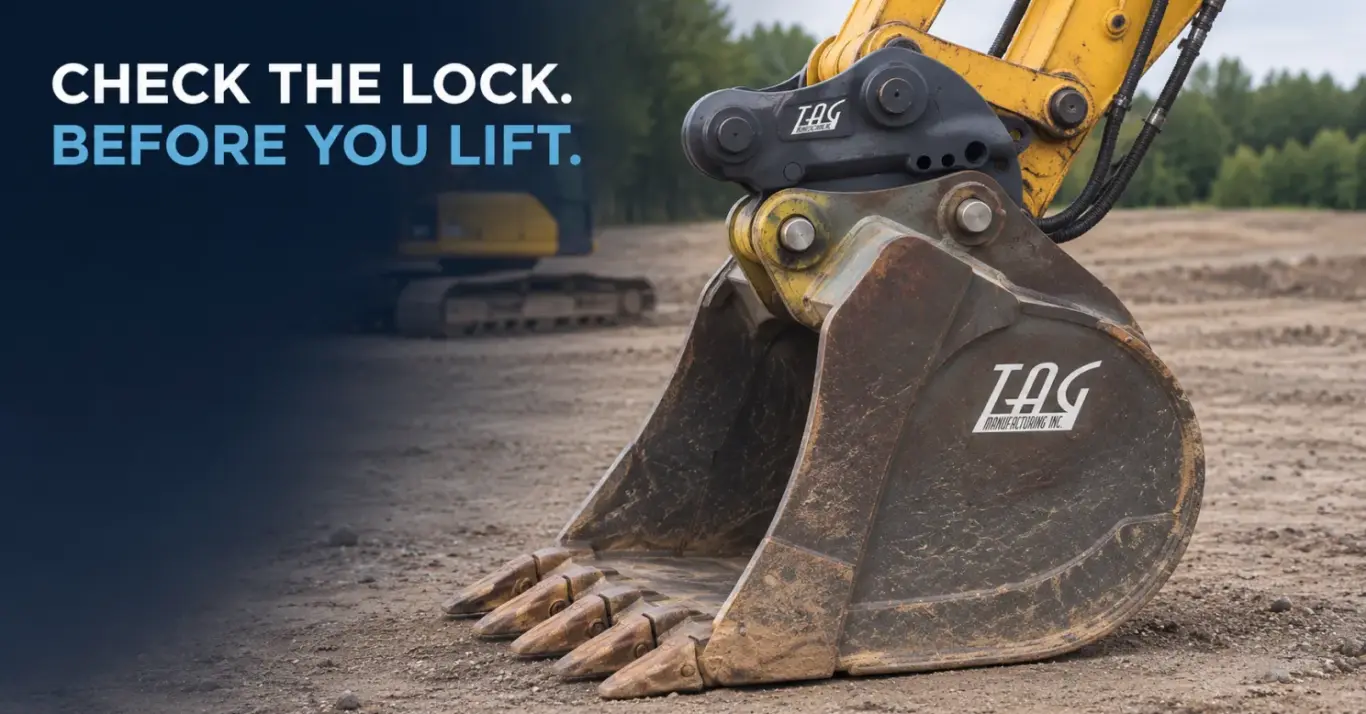
You know it’s locked when you’ve seen the lock engaged and tested the attachment against the ground before lifting it. After every change, set the attachment down and press or curl it against the ground [Engineering review required: confirm generic post-change test wording for each TAG coupler type]. If the coupler isn’t fully engaged, you want to find out a foot off the dirt, not while swinging over a trench with someone in it.
Look as well as test. A latch can appear shut from the cab when it isn’t, and mud packed into a hook can stop a jaw short of fully closed.
The Hydraulic Multi-Lock Coupler has a specific check on our product page. Before operating, visually confirm that the safety pin or prop lock is fully closed and locked, and read the operator’s manual first.
HSE’s inspector guidance asks for automatic hitches whose locking “does not rely on hydraulic pressure to hold the latch.” ISO 13031 is the international safety standard for quick couplers on earth-moving machinery, and ISO reviewed and confirmed it in 2022. Ask any supplier which of its couplers are designed to it, including us [TAG to confirm: which TAG couplers are designed to ISO 13031].
A post on NIOSH’s Science Blog, written with California’s fatality investigators, described three deaths since 2019 in which a bucket fell from a coupler. It noted that an empty excavator bucket can weigh 900 pounds, which is an industry-general figure and not a TAG specification. Its advice starts from the right premise: “always assume that a quick coupler has the potential to fail.”
Keep people out of the swing radius during every change. The daily walk-around, the in-cab indicators, and what “locked” looks like on each coupler type are covered step by step in quick coupler safety: daily checks and how to confirm a locked attachment.
Signs a Coupler Needs Attention
A coupler needs attention when the attachment knocks or rocks on it, when the latch won’t seat, or when the lock indicator and what you see don’t agree. Play usually points to pin-bore wear in the attachment’s ears, or to worn pins and hooks on the coupler [Engineering review required: wear limits for coupler hooks, pins, and attachment bores]. A latch that won’t seat usually has debris in the way or a worn or bent hook.
Stop using the coupler until someone has inspected it. Don’t weld a patch over a crack, because the crack keeps spreading under the patch and the cause stays hidden. Repair the crack with proper weld preparation, and fix what caused it.
What to Have in Hand Before You Call
Bring these details to the call, and the coupler question can usually be settled in one conversation.
- Write down the make, model, operating weight, and serial number of every machine the coupler might go on.
- Note the coupler on each machine now, if there is one, and take a photo of it.
- List every attachment you plan to run, with its pattern or its pin-on dimensions.
- Measure pin diameters and pin spreads instead of looking them up.
- Estimate how many changes a day each machine makes, and note whether your crew or renters run it.
Before you cut and reweld bucket ears to make a coupler fit, call us. Our warranty excludes products field-modified by unauthorized personnel. Normal wear isn’t a defect either, and parts meant to wear down aren’t warranty items. Warranty questions go to our Customer Success Team through our contact page.
Guides for This Topic
- Quick Couplers for Excavators, Backhoes, and Wheel Loaders: A Buyer’s Guide
- Pin-Grabber vs Dedicated Couplers: What Rental Fleets Should Standardize On
- Mechanical vs Hydraulic Quick Couplers: Cost, Cycle Time, and Operator Safety
- From a Napkin Sketch to a Rental Standard: How the QC27 Coupler Simplified Compact Fleets
- Quick Coupler Safety: Daily Checks and How to Confirm a Locked Attachment
- Tilting Couplers Explained: When a Powertilt Beats Swapping Buckets
- Inside the Dromone Multi-Lock: Pick-Up Range, Breakout, and Machine Fit
- Wheel Loader Couplers Compared: Series 9, Xtreme Duty, Hydra Multi-QC, and Hydra-II
- How to Measure Your Machine for a Coupler: Pin Diameter, Pin Spread, and Stick Width
- One Coupler, More Work: The Hydra-II Wheel Loader Multi-Coupler on the Job
- Using a Thumb with a Quick Coupler: Main-Pin Thumbs That Keep Working After a Swap
- Excavator Bucket Guide: Duty Classes, Bucket Types, and How to Choose for Your Ground
Talk to the People Who Build It
Call us at (888) 490-0501, or reach the TAG Customer Success Team through our contact page. The team is 11 people with more than 150 years of combined industry knowledge, and they’ll help you match the coupler to the machine before the dirt flies.
Fast. Rugged. Reliable.
Frequently Asked Questions
Will a quick coupler fit any excavator?
No. A coupler is sized to the machine’s pin diameter, pin spread, and stick width, and those vary by brand and size class. A pin-grabber accepts a range of pins, while dedicated and wedge couplers fit one interface only. Measure instead of trusting the model number, because worn pins, oval bores, and swapped sticks change the answer.
Does a quick coupler reduce digging force?
Usually a little. A coupler moves the teeth farther from the main stick pin, and that longer tip radius reduces breakout force at the teeth. How much depends on the coupler’s height and the machine. A dedicated coupler that holds the bucket closer to the stick usually costs less force than a bulkier pin-grabber.
Is a hydraulic coupler worth it on a mini excavator?
It depends on how often you swap and who runs the machine. A mini that changes attachments several times a day can save hours a week from the cab. A mini that keeps one bucket on all week rarely earns back the extra price and plumbing. Rental fleets often choose hydraulic because they’ll never meet the operator.
Can one coupler pick up attachments from different brands?
Yes, within limits. On excavators, a pin-grabber picks up pin-on attachments from different makers as long as their pins fall inside its pick-up range. On wheel loaders, our Hydra-II Quick Coupler takes JRB and John Deere Hi-Vis or Volvo ISO attachments, and our Hydra Multi-QC Coupler adds CAT IT. Confirm the exact pattern of each attachment before you order.
What’s the difference between a pin-grabber and a wedge coupler?
A pin-grabber clamps onto the attachment’s own pins, so it accepts many pin-on attachments but adds length and weight to the end of the stick. A wedge coupler, such as the John Deere Wedge system, locks onto a matching interface welded to the attachment. It sits closer to the stick, but every attachment needs that interface.
Does TAG’s warranty cover quick couplers?
Yes, for defects. We warrant new products against defects in material and workmanship for one year from the date of original purchase. Normal wear, misuse, misapplication, and field modification by unauthorized personnel aren’t covered. To start a claim, send digital photos and get written approval from us or an authorized TAG representative before any repair begins. Warranty questions go to our Customer Success Team.