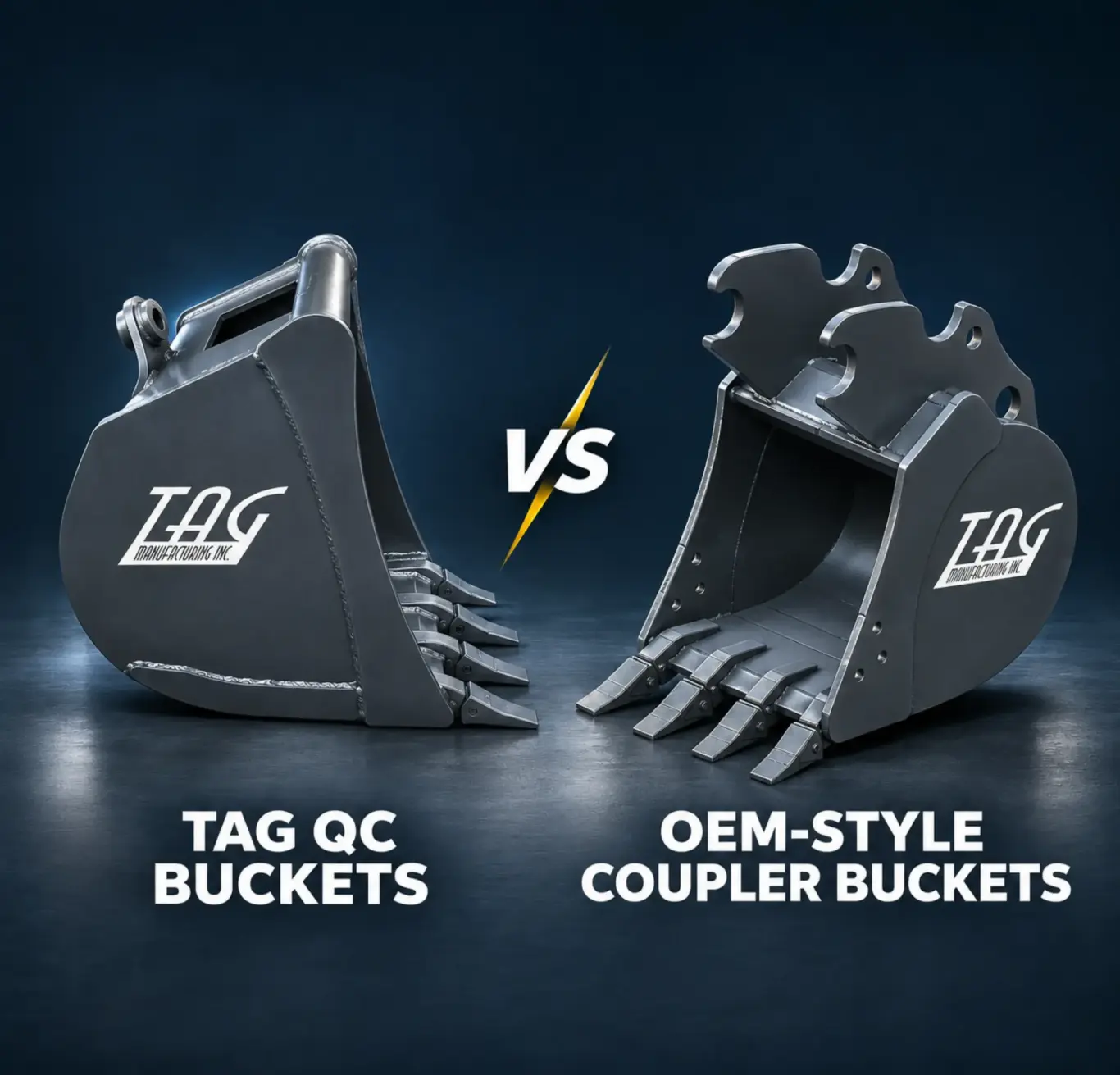
The bucket that fits your quick coupler is the one built to that coupler’s interface, whatever brand of machine it sits on. So start with the coupler on the end of the stick, the arm the bucket hangs from.
If that coupler is a TAG QC27 or QC30, you want a TAG QC Bucket. If your compact excavator came with a John Deere Wedge, Kubota Quick Attach, or Bobcat X-Change coupler, you want an OEM Style Quick Coupler Bucket built to that factory pattern. If you run a pin-grabber coupler or no coupler at all, you want a standard pin-on bucket with the right pin diameter and ear spacing.
This post is one part of our excavator bucket guide, which covers duty classes, bucket types, and ground. Here we cover only the interface, the part of the bucket that meets the coupler. We’ll walk through the three ways a bucket attaches, what each of our coupler bucket lines fits, how to identify your coupler, how to handle a mixed fleet, and what to check when a bucket won’t go on.
Why Does the Bucket Have to Match the Coupler?
The bucket has to match because a quick coupler locks only onto the shape it was built for. The hook, wedge, or jaws engage a specific geometry on the back of the bucket: pin diameter, pin spacing, ear thickness, and the position of the lock features. Change any one of those, and the bucket either won’t seat or will seat without a positive lock. A bucket that seats but doesn’t lock is worse than one that doesn’t fit, because it looks right until it drops.
Excavator bucket coupler compatibility is a question of pattern, not of the badge on the cab. You need the exact interface name and, on a dedicated coupler, the exact size.
Regulators have seen what happens when the lock isn’t made. The UK’s Health and Safety Executive reviewed fatal quick hitch incidents, and its industry guidance on quick hitches reports that the common factor was “a missing retaining pin or bar.” Quick hitch is the UK term for a quick coupler. In those incidents, the bucket was on the coupler, but nothing was holding it there.
Safe Work Australia’s information sheet on quick hitches for earthmoving machinery explains that every hitch has two layers of protection: a primary retaining system and a backup safety system. On automatic hitches, the operator can engage and check the safety device from the seat. Both layers assume the bucket is built to the coupler’s pattern, so a bucket that only looks close can leave neither one doing its job. [Engineering review required]
Check the lock every time you change attachments, the way the coupler’s manual describes. Our guide to quick coupler safety checks shows how to confirm that an attachment is locked.
What Are the Three Ways a Bucket Attaches to an Excavator?
A bucket attaches in one of three ways: direct pin-on, a dedicated coupler built to one attachment pattern, or a pin-grabber coupler that clamps the bucket’s own pins. That holds for nearly every bucket on a 1 to 25 ton excavator. Each method needs a different bucket, so the first thing to settle is which one is on your machine.
Pin-On
Pin-on is the original method, with no coupler between the stick and the bucket. The bucket’s ears, the two bored plates on the back of the bucket, line up with the end of the stick and the link, and two pins pass through both. Nothing else sits in the load path, so the bucket hangs as close to the stick as it can.
That short distance matters for breakout force, the force the machine can put on the teeth to tear material loose. A coupler adds length between the stick and the bucket. That increases the tip radius, the distance from the bucket’s pivot pin to its teeth, and a longer tip radius means less breakout force. A coupler also adds weight at the end of the stick, which comes up again in the lift check below.
The downside of pin-on is swap time. Changing a pin-on bucket means knocking out two pins, lining up the new bucket, and driving the pins back in. If you swap attachments more than a couple of times a week, pin-on is where you lose the most time.
Three measurements define a pin-on bucket: the pin diameter, the center-to-center distance between the pins, and the inside width between the ears. A pin-grabber has to accept those same numbers.
Dedicated Couplers (Factory OEM and TAG QC Patterns)
A dedicated coupler is built to one attachment pattern. The coupler stays pinned to the stick, and every bucket carries a matching set of lock features on its back. The John Deere Wedge, Kubota Quick Attach, and Bobcat X-Change systems are factory examples. Our QC27 and QC30 couplers are another, built around our Adjust-A-Hook design.
A dedicated coupler is fast and repeatable, because every attachment in the set is built to the same drawing. The trade-off is that attachments built to any other pattern don’t fit. Once a dedicated coupler is on the stick, every bucket you add has to be built to its pattern.
Pin-Grabber Couplers
A pin-grabber clamps the bucket’s own pins instead of locking onto a pattern. One jaw hooks the front pin, and a moving jaw, driven hydraulically or mechanically, closes on the rear pin. Because it grabs pins, it can run any pin-on bucket whose pin diameter and center-to-center distance fall within its range. That’s why pin-grabbers are common in rental yards that take in attachments from many sources.
That range has limits. Many pin-grabbers are sized around one machine brand’s pin diameter and pin spacing, so one that closes on that brand’s buckets won’t necessarily close on another’s.
If you run a pin-grabber, order a standard pin-on bucket with pins sized to the coupler’s range. Our guide on pin-grabber vs dedicated couplers for rental fleets covers when each coupler type is the better buy.
What Is the TAG QC System, and Which Bucket Fits It?
The TAG QC system is our own dedicated coupler interface, and the TAG QC Bucket is the bucket built to fit it.
The TAG QC Coupler comes in two sizes, and we build and machine both in Chattanooga, Tennessee. The QC27 is for mini and compact machines, and the QC30 is for heavier attachments on a full-size excavator. Both use our Adjust-A-Hook design, and both let the operator lock buckets, thumbs, and other attachments onto the machine without leaving the cab. For a crew that swaps between a digging bucket, a ditching bucket, and a thumb several times a day, that’s where the time comes back.
The QC27 started on a napkin. Our co-founder Gary Wilt sketched it on a flight from San Diego to Atlanta, and Takeuchi was the first OEM to adopt it for national rental companies. Today the TAG Quick Coupler System gives a unified attachment interface across 2 to 6 ton compact excavators. It’s the preferred setup for United Rentals, Sunbelt Rentals, and other national fleets, so if you rent compacts from a national yard, you may already have run a QC27.
The TAG QC Bucket is a Heavy Duty bucket built with the TAG QC interface on its back instead of pin-on ears. It also comes in a ditch version, so a wide ditching profile is available on the same interface. [TAG to confirm: which widths and profiles are offered on the TAG QC interface, and whether QC30-pattern buckets are listed separately]
If the coupler on your stick is a TAG coupler with the Adjust-A-Hook, order TAG QC Buckets and tell us whether it’s a QC27 or a QC30. Don’t order an OEM Style bucket and hope the pattern is close.
What Do OEM Style Quick Coupler Buckets Solve?
The OEM Style Quick Coupler Bucket lets a compact excavator keep its factory coupler and still run a TAG-built bucket. We build it for compact excavators equipped with John Deere Wedge, Kubota Quick Attach, or Bobcat X-Change coupler systems. Its direct OEM-pattern interface mounts to the factory coupler the same way the machine maker’s own bucket does.
The situation it fixes is common. A contractor buys a Kubota compact with the factory Quick Attach, a Bobcat with X-Change, and a Deere with the Wedge, because each dealer had the right machine at the right time. Later, the contractor wants a different bucket profile or needs a replacement quickly. Only buckets built to each factory pattern will fit, and that can mean waiting on three different parts counters.
An OEM Style bucket handles that without changing anything on the machine. You keep the factory coupler and the swap routine your operators already know, and the bucket itself is a TAG Heavy Duty build. We build the line for general excavation, utility work, and site prep.
“OEM Style” means built to one named factory pattern, so a Bobcat X-Change bucket fits X-Change couplers and nothing else. Factory couplers also come in more than one size within each brand, matched to machine class. Give us the machine model along with the pattern. [TAG to confirm: which OEM coupler sizes and machine classes are covered for each of the three patterns]
What Do TAG QC Buckets and OEM Style Buckets Have in Common?
Behind the interface, both lines are TAG Heavy Duty buckets. The coupler pattern on the back differs, but the shell, profile, and reinforcement come from the same family. Choosing an interface doesn’t push you into a lighter bucket.
Both lines carry the same four structural features. Together they give you quicker loading and more yardage on each pass, with higher strength and fewer failures.
- Double bottom shells. An outer wear skin sits over an inner structural shell. Wear on the outside doesn’t breach the structure that holds the bucket together.
- Smooth, unobstructed openings. The opening has no internal ledges or braces for sticky material to hang on. In clay or wet fill, that helps the bucket dump clean instead of carrying part of its load back to the trench.
- Internal reinforcements. The TAG QC Bucket uses internal tube reinforcements, and the OEM Style bucket uses internal triangle reinforcements. Both brace the shell from the inside so the sides don’t spread under corner loading. [TAG to confirm: whether the reinforcement style differs between the two lines or the product pages simply describe it differently]
- Double radius and dual taper profile. The curve of the floor and the taper of the sides let material roll in as you curl the bucket and fall out cleanly when you dump.
If your ground is abrasive enough to call for a higher duty class, tell us before you order, because the interface and the duty class are separate choices. [TAG to confirm: whether Severe Duty buckets can be ordered with the TAG QC interface or an OEM pattern] Our post on choosing a bucket duty class for your ground covers that decision.
How Do You Tell Which Coupler Is on Your Machine?
Walk to the end of the stick and check three things: the shape of the lock, the decals, and the pins. If it doesn’t, measure the pins and call us with the numbers.
Look at the lock. On a wedge coupler, you’ll see a sloped wedge that drives into a matching pocket on the bucket. On a TAG QC coupler, you’ll see the hook and our Adjust-A-Hook mechanism. A pin-grabber has a fixed jaw at the front and a moving jaw at the rear, both shaped to close around a round pin, and the bucket still has its own pins in it. If there’s no coupler and the ears are pinned straight to the stick and link, you have pin-on.
Read the decals and castings. Factory couplers usually carry the system name, such as Kubota Quick Attach, Bobcat X-Change, or John Deere Wedge. Our couplers carry the TAG name and the model. [TAG to confirm: where the TAG name and the QC27 or QC30 model are marked on the coupler] Aftermarket pin-grabbers usually carry the coupler maker’s name. If the decal has worn off, the shape still tells you which family you’re in.
Measure the pins and the spacing. On a pin-grabber or pin-on setup, the bucket pins are the spec. Measure the three pin-on dimensions on the machine, not the old bucket, because the old bucket may be worn or may have been a compromise fit to begin with. Write them down with the machine’s make, model, and operating weight. On a dedicated coupler, you still need the weight class, because both factory couplers and our QC couplers are sized by machine class.
Check the rental paperwork. If the machine is a rental, the yard’s paperwork usually names the coupler. A compact from a national fleet carries the coupler that fleet standardized on, and that may be our QC27.
Our guide on how to measure your machine for a coupler walks through each measurement step by step. The three pin measurements plus the machine model are enough for our Customer Success Team to match a bucket.
Mixed Fleet: Standardize on One Coupler or Match Each Machine?
Standardize on one coupler pattern if you own the machines and swap attachments often. Match buckets to each machine’s coupler if you rent, run several brands with factory couplers, or rarely swap. Most fleets end up doing some of both.
Standardizing means fitting the same coupler to every machine in a weight class and building the attachment pool to that one pattern. Any bucket or thumb in the yard then fits any machine in the class, and spares cover the whole fleet. That’s the thinking behind our QC system on 2 to 6 ton machines. The cost is the couplers themselves, plus any attachments built to the old patterns, which stop fitting the moment you switch.
Matching means leaving each machine’s factory coupler alone and buying buckets to its pattern. You pay nothing to change over, but the attachment pool splits by pattern. The Kubota buckets stay with the Kubotas, which is a nuisance at three machines and a planning problem at 30. OEM Style buckets suit this approach, because they let you keep the factory couplers and still buy every bucket from one supplier.
These rules cover most fleets:
- If every machine is the same brand with the same factory coupler, match. OEM Style buckets built to that pattern cover you.
- If the fleet mixes brands, is mostly owned, and moves attachments between machines every week, standardize on one coupler per weight class.
- If the fleet is mostly rented, match. You don’t control which coupler arrives on the next machine.
- If you run pin-grabbers, you already have the most flexible interface, and the bucket question comes down to pin size and spacing.
An illustration with assumed numbers. Say you own six compact excavators in one weight class: two Kubotas, two Bobcats, and two Deeres, each on its factory coupler. If you match, every specialty bucket you want available to the whole fleet has to be bought three times, once per pattern. If you standardize, you buy each specialty bucket once or twice and share it, but you pay for six couplers, and the buckets you already own stop fitting.
On those assumptions, matching costs less while each machine runs its own digging bucket and little else. Standardizing starts to pay once three or four specialty buckets, such as a ditching bucket, a tilt bucket, and a rock bucket, move around the fleet every week. Price your own couplers and buckets before you decide.
TAG QC Bucket vs OEM Style vs Pin-On: Side by Side
The table compares the three bucket interfaces on the points that drive the purchase.
| Pin-on bucket | TAG QC Bucket | OEM Style Quick Coupler Bucket | |
|---|---|---|---|
| Works with | Direct pin-on (no coupler), or a pin-grabber sized to the pins | TAG QC27 (mini and compact) or QC30 (full-size) couplers | Factory couplers: John Deere Wedge, Kubota Quick Attach, and Bobcat X-Change |
| Swap method | Drive out two pins and drive them back in, or clamp the pins with a pin-grabber | Lock from the cab with the Adjust-A-Hook, with no pin removal | The factory coupler’s own lock, following that machine maker’s routine |
| Interchange across brands | Yes, when pin diameter and center-to-center distance match the stick or the pin-grabber’s range | Any machine fitted with the same TAG QC model, regardless of brand | Only machines running the same factory pattern and size (Kubota to Kubota, for example) |
| Reversibility | Some pin-grabbers can pick up a bucket turned around, depending on the coupler design | [TAG to confirm: whether TAG QC Buckets can be mounted reversed on the QC27 and QC30] | [TAG to confirm: whether OEM Style buckets can be mounted reversed on each factory pattern] |
| Structural build | Varies by duty class (see our excavator bucket guide) | TAG Heavy Duty: double bottom shells, smooth openings, internal tube reinforcements, and a double radius and dual taper profile | TAG Heavy Duty: the same features, with internal triangle reinforcements |
| Best for | Single-bucket machines, pin-grabber fleets, and the shortest tip radius | 2 to 6 ton compacts standardized on TAG QC, and full-size machines with a QC30 | Mixed fleets keeping factory couplers on Deere, Kubota, or Bobcat machines |
How to read this table: Find your coupler in the “Works with” row, which is the only row a different bucket can’t change. Then read down that column to see what you get and what you give up.
Why Won’t a Mini Excavator Bucket Fit the Coupler?
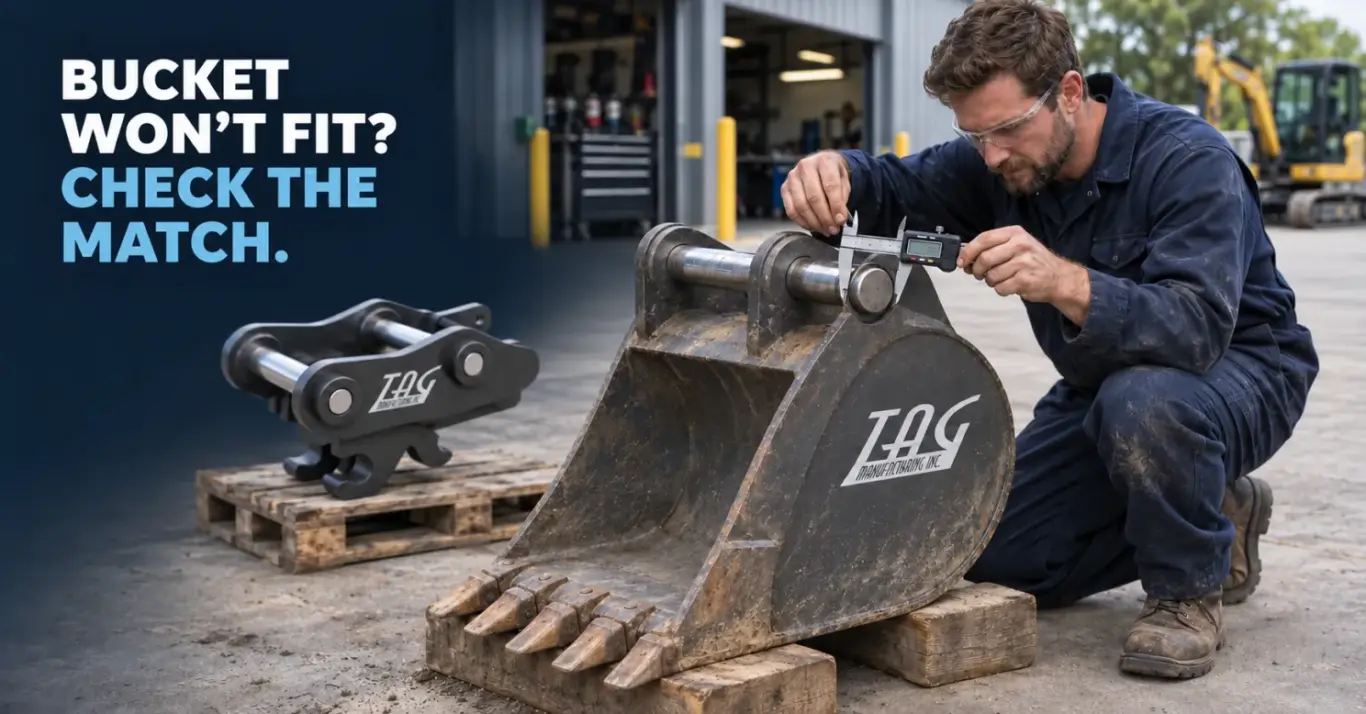
A mini excavator bucket that won’t fit the coupler almost always has the wrong interface, the wrong size within the right interface, or worn or bent mounting points. What you see at the machine tells you which one.
The bucket won’t seat at all. The interface is wrong. A pin-on bucket offered up to a dedicated coupler, or a bucket built to one factory pattern offered up to another, gives the lock nothing to engage. Identify both the coupler and the bucket before anyone reaches for a pry bar or a hammer.
The jaws reach the pins but won’t close. On a pin-grabber, this usually means the pin diameter or the center-to-center distance falls outside the coupler’s range. Measure both on the bucket and compare them with the coupler’s accepted range. Don’t force the jaw closed.
The bucket hooks on but sits crooked or rocks. The pattern may be right while the size is wrong, or the mounting points may be damaged. Side load and impact bend bucket ears, and pin movement wears the bores oval. A bucket with bent ears or pin-bore wear won’t sit square on any coupler until the ears and bores are repaired.
The lock won’t fully engage. Stop, and don’t dig with that bucket. Check the lock pockets for packed dirt or debris first. If they’re clean and the lock still won’t close, the pattern or the size is wrong, so call us before the bucket goes back to work. [Engineering review required]
What Are the Common Mistakes When Buying a Coupler Bucket?
The common mistakes are buying by width alone, assuming “quick attach” is one standard, mixing factory patterns that look alike, forgetting the thumb, and skipping the lift check after a coupler change. The first three leave a bucket on the ground that won’t go on the machine. The last two cause trouble after it’s on.
Buying by width alone. Width is the first number everyone asks for, and it’s the wrong first number. A 24-inch bucket for a 3-ton machine might be built pin-on, for a TAG QC coupler, or to any of three factory patterns, and only one of those fits your stick. Decide the interface first and the width second. Our guide to excavator bucket width by machine size covers the width decision.
Assuming “quick attach” is universal. It isn’t. Kubota uses the phrase for its factory system, dealers use it for pin-grabbers, and online listings use it for anything with a coupler. When a seller calls a bucket quick attach, ask which pattern. If the seller can’t name it, don’t buy it.
Mixing factory patterns. Factory couplers from Deere, Kubota, and Bobcat can look alike in a photo, but they aren’t interchangeable. A John Deere Wedge coupler bucket won’t lock properly on a Kubota Quick Attach coupler, and forcing it is how a bucket ends up seated but unlocked. If the machine was ever fitted with an aftermarket coupler, check the pattern on the coupler itself.
Forgetting the thumb. If you run a thumb, it has to clear the bucket when the bucket is curled in, and it has to work with the coupler. A bucket that fits the coupler but hits the thumb is still the wrong bucket. Mention the thumb when you call, and see our guide to using a thumb with a quick coupler for thumbs that keep working after a swap.
Skipping the lift check after a coupler change. The weight a coupler adds at the end of the stick changes what a small machine can safely lift at full reach. United Rentals’ bucket selection guide points out that a machine’s published lifting capacity may or may not already include the bucket’s weight, so read the lift chart’s notes before you count on a number. Rerun your lift check after any coupler change. [Engineering review required]
Guides for This Topic
- Excavator Bucket Guide: Duty Classes, Bucket Types, and How to Choose for Your Ground
- Pin-Grabber vs Dedicated Couplers: What Rental Fleets Should Standardize On
- How to Measure Your Machine for a Coupler: Pin Diameter, Pin Spread, and Stick Width
Talk to the People Who Build It
Call (888) 490-0501 or reach the TAG Customer Success Team through our contact page, and we’ll match the bucket to the coupler you already have. Have these ready:
- Your machine’s make, model, and operating weight
- The name of the coupler on the stick, or the pin diameter and center-to-center distance if you’re not sure
- Whether you run a thumb
- A plain description of the ground you work in
Fast. Rugged. Reliable.
Frequently Asked Questions
Will a TAG QC Bucket fit a Kubota Quick Attach coupler?
No. The TAG QC Bucket is built with the TAG QC interface for our QC27 and QC30 couplers, and Kubota Quick Attach is a different factory pattern. For a Kubota factory coupler, order an OEM Style Quick Coupler Bucket built to the Kubota pattern. Both lines share the same Heavy Duty construction, so only the interface on the back of the bucket changes.
What is the difference between a QC27 and a QC30?
The QC27 is sized for mini and compact excavators, and the QC30 is for heavier attachments on a full-size excavator. Both are TAG QC couplers with our Adjust-A-Hook design, and both lock attachments on from the cab. The QC27 is the coupler behind our unified interface on 2 to 6 ton compacts. Tell us which model is on your machine when you order a TAG QC Bucket.
How do I know which coupler is on my mini excavator?
Look at the fixture between the stick and the bucket. A pin-grabber has jaws that close around the bucket’s own pins, a wedge coupler drives a sloped wedge into a pocket on the bucket, and a TAG QC coupler has a hook with our Adjust-A-Hook mechanism. Factory couplers usually carry the system name. If the decal is gone, measure the pins and call us.
Can I put an OEM Style bucket on a machine from a different brand?
Only if that machine runs the same factory coupler pattern in the same size. OEM Style buckets are built to a named pattern, such as John Deere Wedge, Kubota Quick Attach, or Bobcat X-Change, and not to a machine brand. If a machine has been refitted with a different coupler, the coupler now on the stick decides which buckets fit. Order by the coupler pattern and size.
Do I need a quick coupler to use a TAG bucket?
No. We build standard pin-on buckets as well as TAG QC and OEM Style coupler buckets. If your machine has no coupler or runs a pin-grabber, order a pin-on bucket with the right pin diameter and center-to-center spacing. A dedicated coupler makes sense when you swap attachments often enough for the saved time to cover its cost and the weight it adds to the stick.
Can a bucket be mounted backwards on a quick coupler?
It depends on the coupler. Because a pin-grabber clamps pins rather than locking onto a pattern, some pin-grabbers can pick up a bucket turned around, so check the coupler’s manual first. On a factory coupler or a TAG QC coupler, ask us before you rely on reverse mounting, because it depends on the hook and lock geometry of both the coupler and the bucket.