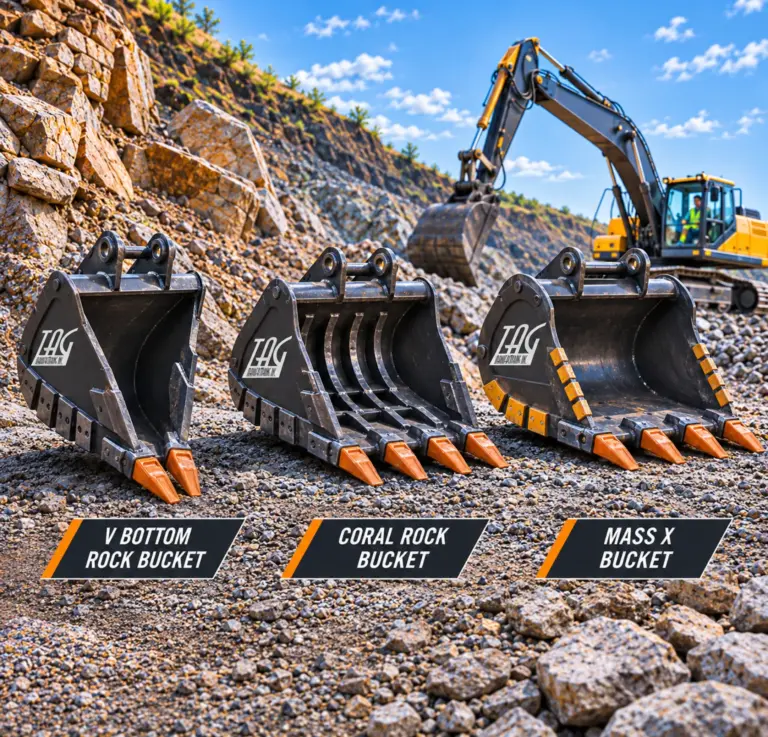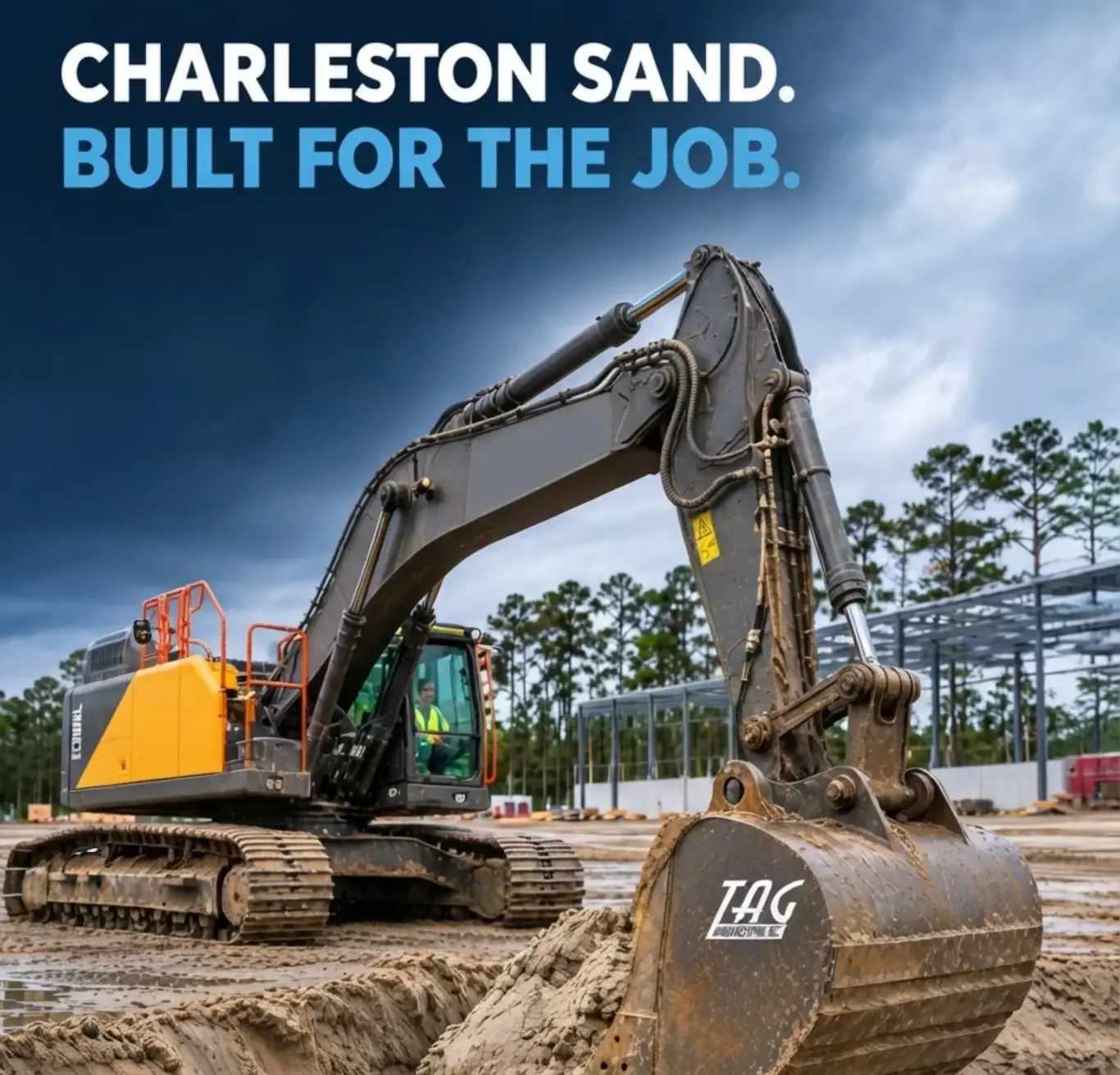
Our “In the Dirt” jobsite series started in Charleston, South Carolina, in wet sand that is hard on steel. The right excavator bucket for sandy soil like the Low Country’s has side wear plates, wear strips you can replace, a shell that keeps its shape, and a profile that drains and dumps clean. For wet, high-silica sand with a high water table, that means a Severe Duty bucket. [TAG to confirm: duty class for wet, high-silica coastal sand]
On that job, Landmark Construction was doing sitework and underground utilities for a new warehouse. The crew ran Volvo excavators from Ascendum Machinery with TAG excavator buckets on them. Our excavator bucket guide covers duty classes and bucket types for the main kinds of ground, and this post stays in one of them. Below, we look at what wet sand does to a bucket, what’s under Charleston, and five lessons from the job: duty class, wear parts, drainage, dealer support, and inspection.
What Does Wet, Abrasive Sand Do to an Excavator Bucket?
Wet, abrasive sand grinds steel off a bucket everywhere the sand slides across it. It wears the sides where the bucket rubs the trench wall. It wears the heel and the underside where the bucket drags along the bottom of the cut. It also rounds the cutting edge, blunts the teeth, and scours the inside of the shell as each load slides out.
None of this shows after a single day. The wear builds with every pass, and the ground sets how fast it builds. That’s why bucket wear in wet sand catches crews off guard. The bucket looks fine until the shell itself starts to lose thickness.
So the question for sandy, wet ground isn’t how strong the bucket is. You’re asking four things:
- Is there sacrificial steel on the sides, where the trench wall does its grinding?
- Can the parts that wear fastest be replaced without cutting up the bucket?
- Does the shell hold its shape, so the bucket still fills and dumps the way it did when it was new?
- Does the bucket drain, so you aren’t lifting water and carrying packed wet sand on every cycle?
The Jobsite: A Warehouse Pad and the Utilities Under It
Landmark Construction, a civil contractor, had the complete sitework and underground utility installation for a new warehouse in Charleston. Evans Construction was the general contractor. Ascendum Machinery, the Volvo dealer in Charleston, supplied the excavators, which ran TAG excavator buckets.
Sitework and underground utilities on a warehouse pad mean a lot of trench, and in the Low Country much of that trench goes in below the water table. Michael McGavin, Utility Manager at Landmark, said his crew works in “deep nasty conditions with a lot of water coming in at us.” That is utility trenching in sandy soil at its hardest. The sand shifts as you dig, and water collects in the bottom of the cut.
What’s Under Charleston, and Why Does It Matter for a Bucket?
Under Charleston, you’ll usually find fine, quartz-rich sand on top and, in many places, finer and stickier soil below it. Water sits close to the surface across much of the area. Each layer wears or loads a bucket in its own way, so digging in Charleston sand asks more of a bucket than the word “sand” suggests.
The soil series descriptions published by the USDA Natural Resources Conservation Service (NRCS) show the pattern. Two Charleston County soils make the point.
Wando sand. The Wando series was established in Charleston County. It’s a well-drained sand that soil scientists class as a Quartzipsamment, a sand made up mostly of quartz. Its seasonal high water table sits 48 to 72 inches below the surface from January to March, so in those months a utility trench that goes below 4 to 6 feet reaches wet sand.
Yonges loamy fine sand. The Yonges series is another Charleston County soil. It’s a poorly drained loamy fine sand over sandy clay loam or clay loam. Its water table is within 10 inches of the surface for about six months in most years, so the water is there before you start digging.
Soil surveys describe an area, not your site. Your geotechnical report is the final word for any one job.
The sand on top is the abrasive layer. It’s loose, it shifts, and it’s full of hard grains. That’s where the sides and the heel take their wear, and it’s where the crew spends the most cycles.
The clay loam below the sand is sticky rather than abrasive. It packs into the corners of a bucket and rides back down into the trench instead of dumping.
Water is the third factor. Dewatering lowers the water table, but it doesn’t dry the sand. Every bite comes up wet and leaves wet grit on the steel.
Why Is Wet Sand One of the Most Abrasive Things a Bucket Meets?
Most sand is largely quartz, and quartz is one of the hardest minerals a bucket digs. Ground conditions change wear rates, and quartz content is a big reason why. Quartz is far harder than the calcite in limestone, so the same bucket can wear slowly on one site and too fast on the next.
The steel maker SSAB notes that the hardness of an abrasive plays a major role in wear. It rates quartz at 1,070 on the Vickers hardness scale, compared with 725 for feldspar and 60 for calcite.
Common AR400 abrasion-resistant plate sits around 360 to 440 on the Brinell scale, according to Olympic Steel. The two scales don’t convert one to one, but the gap is wide. A quartz grain is harder than the plate it slides across. These are industry-general figures, not TAG specifications.
Water makes it worse. It holds the grit against the shell and washes away the finest particles, so sharp grains keep reaching the steel. Wet sand is harder on a bucket than dry sand, and a Low Country utility trench puts quartz-rich sand and constant water together.
Rock damages a bucket mostly through impact. Sand wears it down through friction on every pass. In wet coastal sand that friction never lets up, and a contractor there sees wear that a contractor in dry inland loam might never see.
What the Crew Said About Digging Sand with TAG Buckets
Chris Varnadore, Landmark’s Director of Equipment and Shop Operations, told us the TAG bucket has been a great fit for Charleston’s sandy soil and holds up well.
Rick Mixson, President of Landmark, said the company runs mainly TAG excavator buckets across its many excavators. His key concern is that attachments last and don’t cause problems in the field. On that basis, he gave us a high recommendation.
Mitch Bailey, Account Manager at Ascendum Machinery, has worked with us for more than 15 years and calls TAG a key account. He said customers like the bucket designs and the durability in sandy, abrasive soil. Bailey also said Ascendum has yet to have a TAG bucket recalled or see a bucket failure.
These statements describe one contractor’s and one dealer’s experience in one kind of ground. They aren’t a performance guarantee. The five lessons below explain which parts of the bucket design they’re responding to.
Lesson One: Match the Duty Class to the Abrasiveness, Not to the Machine Size
Pick the duty class by what you’re digging, not by how big the excavator is. A 5-ton machine in wet, high-silica sand needs more wear protection than a 20-ton machine in loam. Machine size sets the width and the pin dimensions, and the ground sets the duty class.
This trips up first-time buyers. They reason that a small machine without much breakout force can get by with a standard bucket. But breakout force isn’t what wears out a bucket in sand. Friction is. A mini excavator trenching in wet sand drags grit across its sides on every pass, just as a large machine does.
We build three duty classes: Heavy Duty, Severe Duty, and SXD (Severe Xtreme Duty), part of our Xtreme Duty line. Here’s how the ground lines up with them.
| Ground you’re digging | Duty class | What the bucket needs |
|---|---|---|
| Topsoil, loam, fill, and ordinary clay | Heavy Duty | A shell that keeps its shape and a smooth opening so material dumps |
| Ordinary sand and loose gravel | Heavy Duty, or Severe Duty if the bucket is wearing too fast | A double bottom shell, so wear on the underside stays on the outer shell |
| High-silica, sharp, or wet sand with a high water table, like Charleston’s | Severe Duty [TAG to confirm: duty class for wet, high-silica coastal sand] | Full side wear plates, full-width replaceable transverse wear strips, extended bucket ears, and larger internal triangle reinforcements |
| Rock, concrete rubble, and compacted clay (mini and compact excavators) | Severe Duty | The same Severe Duty wear protection |
| Mining and extreme-wear applications | SXD | Everything in Severe Duty, plus torque tubes, replaceable vertical shrouds, replaceable heel protectors, and a thicker shell and cutting edge |
How to read this table: Find the row that matches the worst ground you dig regularly, not the average, and read across. The right column lists what we build into each class. The table is our general guidance by ground type, not a statement about what any particular contractor runs.
The Heavy Duty Bucket covers the first two rows. It’s built with double bottom shells, internal triangle reinforcements, smooth and unobstructed openings, and a double radius and dual taper profile. In ordinary sand with less water in it, the double bottom shell matters most, because wear on the underside stays on the outer shell instead of reaching the structural shell behind it. If you have a Heavy Duty excavator bucket wearing out too fast in sand, step up to Severe Duty.
The Severe Duty Bucket is the one to ask for when the sand is wet and high in silica and you dig it every day. It’s built for mini and compact excavators in abrasive ground, with larger internal triangle reinforcements, full-width replaceable transverse wear strips, extended bucket ears, and full side wear plates. Our design goal is that those wear parts wear down instead of the frame behind them.
If you run a larger excavator in that kind of sand, ask us which class fits your machine. [TAG to confirm: duty class for 10 to 25 ton excavators in wet, high-silica sand] Our comparison of Heavy Duty, Severe Duty, and SXD duty classes goes through all three in more detail.
Before you settle on a Severe Duty bucket for sand, check its weight against your machine’s lift chart. [Engineering review required] It’s noticeably heavier than a Heavy Duty bucket of the same width, because it carries the wear strips, full side wear plates, larger internal triangle reinforcements, and extended bucket ears. [TAG to confirm: Heavy Duty and Severe Duty weights at the same width]
Lesson Two: Put the Wear Where You Can Replace It
A bucket built for sand should wear out its replaceable parts, not its shell. The idea behind a Severe Duty design is sacrificial steel between the sand and the structure, and that steel is the part you replace.
On a bucket without added wear parts, the sand takes steel straight off the shell. On a bucket designed for abrasive ground, the surfaces the sand works hardest are covered. Full side wear plates take the trench-wall wear, and the wear strips take the wear on the underside. When a strip wears down, you replace the strip, and the shell behind it keeps its full thickness.
That changes the maintenance math. A bucket with no replaceable wear surfaces has a hard stop, because once the shell is thin, the bucket is done. A bucket with replaceable wear parts is designed so each round of wear costs a set of strips instead of a new bucket. How fast you go through those rounds depends on the ground.
Our Heavy Duty Bucket can be ordered with bolt-on cutting edges, a choice of teeth, and wear shrouds, the guards that cover the cutting edge between the teeth. Extra wear parts can be added, but few buyers order them. A buyer who wants more protection in wet sand normally steps up to a Severe Duty bucket, which carries side wear plates and wear strips as part of its design.
Three shop habits make replaceable wear parts pay off. Our guide to why excavator buckets wear out covers each part in more detail.
Check wear parts on a schedule. Don’t wait for a part to fail. Teeth are consumables, but adapters, the bases the teeth lock onto, are not. If you run teeth until the wear reaches the adapter, a simple tooth change turns into a cut-and-weld job. Replace a cutting edge before the second side rounds over, and replace a wear strip while it still has steel left to protect the underside behind it. [TAG to confirm: TAG’s recommended replacement points for teeth, cutting edge, side cutters, and shell wear]
Keep wear parts in stock. When sand is your everyday ground, wear strips are a consumable, like teeth. Keeping a set on the shelf turns a replacement into a short shop job instead of a wait. [TAG to confirm: whether replacement transverse wear strips and side wear plates for Severe Duty buckets are stocked at TAG or ordered to size]
Watch the sides, not just the teeth. Side wear is slow and quiet, and it happens on the part of the bucket nobody sees from the cab. In trench work in sand, bucket side wear plates often set the replacement schedule. Run a hand down each side wear plate at the cutting edge end every time you grease the machine. If it’s noticeably thinner there than at the ears, plan the replacement now.
Lesson Three: Keep the Bucket Draining and Dumping Clean
An excavator bucket for a high water table has to let the water go and let the sand out. If it doesn’t drain, you’re lifting water on every cycle. If it doesn’t dump clean, you’re carrying packed sand and sticky clay back into the trench on the return swing. Both cost cycle time, and on a utility job, cycle time is production.
The water problem is the simpler one. A heaped bucket of wet sand carries water weight that does no work for you. A smooth, unobstructed opening and a double radius profile help the bucket shed water and let the load slide out cleanly. The more ribs, ledges, and inside corners a bucket has, the more it holds onto.
The sticking problem is the one Charleston adds. The clay loam under the sand sticks to steel when it’s wet. Anything in the load’s path gives that clay something to pack against, and the operator ends up shaking the bucket at the top of every swing.
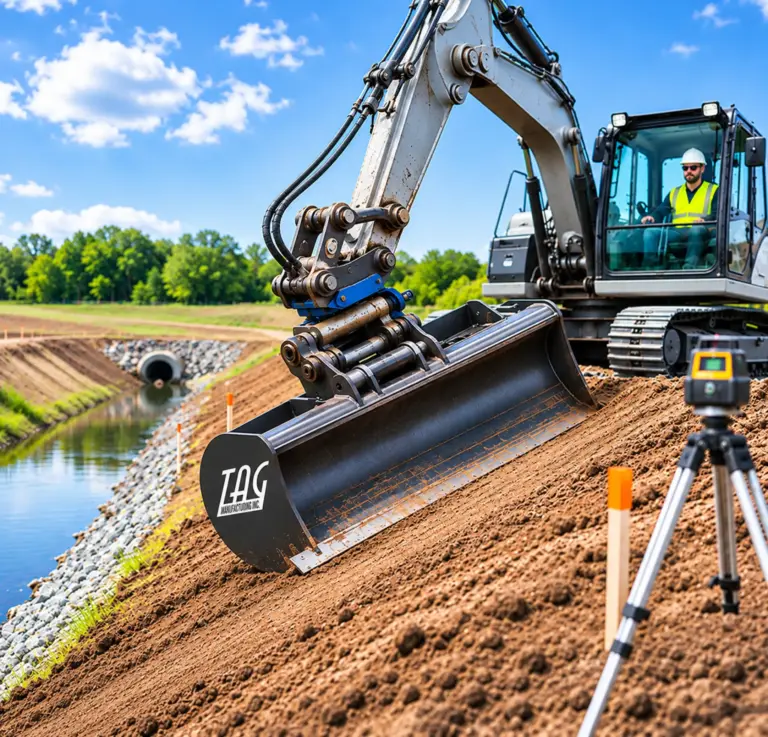
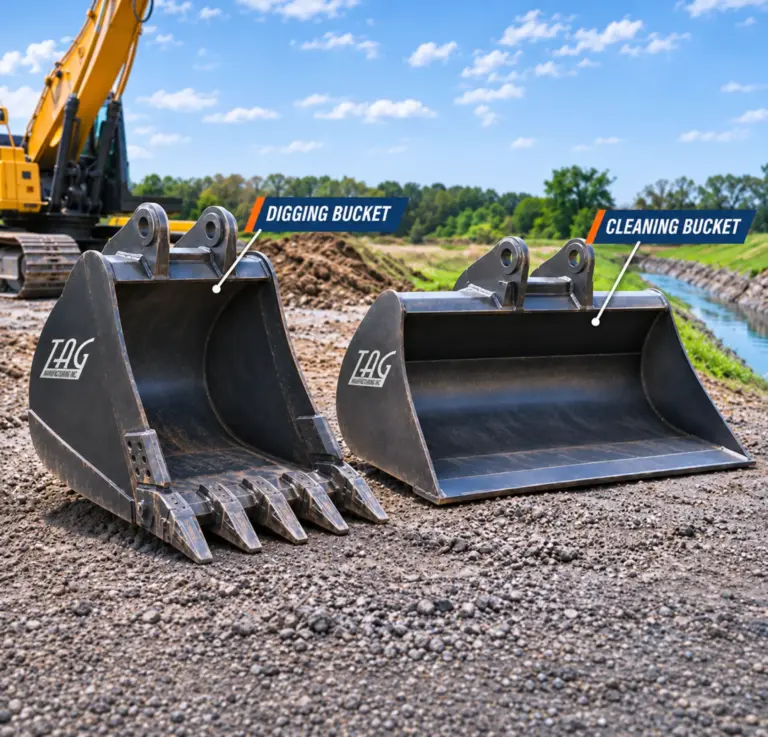
There’s a cleanup side, too. Sitework around a warehouse means drainage ditches and channels to grade after the trenches are backfilled. A digging bucket takes several bites to shape what a wide, shallow ditch cleaning bucket does in one pass, and in sand every extra bite is extra wear. Our post on ditch cleaning buckets versus digging buckets covers when the wide bucket pays off and why its bolt-on, reversible edge takes the wear instead of the shell.
The decision rule is easy to apply. If the bucket comes up carrying standing water, or operators shake it to empty it, the profile is costing you cycles.
Lesson Four: A Dealer Who Stocks the Bucket Matters as Much as the Bucket
The best excavator bucket for sand does you no good if it’s weeks out when you need it. On a utility job with the water coming in, a bucket that goes down is a machine that goes down. The crew ends up standing at the edge of a wet trench. Where the bucket comes from, and how fast it arrives, is part of the buying decision.
The Charleston job shows what that looks like when it works. The dealer that supplied the machines already knew our buckets and how they do in local sand.
Ask your dealer these questions before you buy or rent:
- Do you stock this bucket in the width and pin configuration for my machine, or is it built to order?
- If it’s built to order, what’s the lead time right now?
- Do you stock replacement wear strips, side wear plates, and teeth?
- Have you put this bucket on machines working ground like mine, and what did it look like when it came back?
- If something goes wrong, who inspects it and how fast?
That last question matters because of how our warranty works. We warrant new products to be free from defects in material and workmanship for one year from the date of original purchase. Normal wear isn’t a defect, so teeth, cutting edges, side cutters, wear strips, and side wear plates wearing down as intended aren’t warranty items.
If you believe you have a defect, get written approval before any repair, either from us or from an authorized TAG representative who inspects the attachment. Document the issue with digital photos. Full terms are on our warranty page, and the TAG Customer Success Team answers warranty questions through our contact page.
A dealer who knows the product and the ground can get that inspection done quickly. That’s one reason we sell through dealers, rental companies, and OEM partners. The dealer is the one who sees your machine, your ground, and your bucket.
Lesson Five: Watch the Bucket, Not the Hour Meter
Watch the bucket’s condition, because the hour meter only tells you how long the bucket has worked. It doesn’t tell you what the ground did to it in those hours. A bucket that spent 500 hours in dry inland loam and a bucket that spent 500 hours in a wet Charleston utility trench aren’t the same bucket at the end. A maintenance schedule built on hours alone will miss the second one.
On an abrasive, wet job, walk around the bucket at the start of each week. Check the side wear plates where the trench wall rubs, the heel where the bucket drags on the bottom of the cut, the underside behind the cutting edge, and the teeth. Those are the places sand attacks first.
Check the bucket ears too, but for a different reason. Side load and impact bend bucket ears, and pin movement wears the bores oval. Abrasion isn’t their main problem, so look for bent ears and pin-bore wear.
Measure the wear parts and write the numbers down. Put a tape or a set of calipers on the wear strips and side wear plates at the same marked spots each time. Your first few readings show how fast the ground is taking steel off. That rate, not the hour meter, sets your replacement schedule for teeth, strips, and plates.
Here’s an illustration with assumed numbers, not TAG specifications. Say a side wear plate measures 0.50 inch at the cutting edge end when the job starts, 0.47 inch at the next weekly check, and 0.44 inch at the one after. That’s a loss of about 0.03 inch per check. If the replacement point you’ve set is 0.26 inch, the plate gets there in about six more checks, so order the replacement plates now and have them on the shelf when the plate reaches that point.
Two signs mean a bucket has moved past wear-part maintenance and into structural trouble. The first is an underside behind the wear strips that has worn thin enough to flex. The second is a crack that has started at an ear or at the end of a weld. Either one means the bucket comes off the machine for a proper look.
Don’t let anyone talk you into a quick patch. A crack keeps spreading under a patch weld, and the patch hides whatever caused it. Have the crack prepared and welded properly, and find the cause before the bucket goes back to work. Our inspection checklist walks through all ten points.
Abrasion sets the wear rate in sand, but impact and overload cause most of the structural damage. The habits behind it are side loading, prying, digging with a worn edge, using the bucket as a hammer, and overloading. If a bucket that works only in sand shows bent ears or cracks, look at those habits before you blame the ground.
What “In the Dirt” Is, and Where It Goes Next
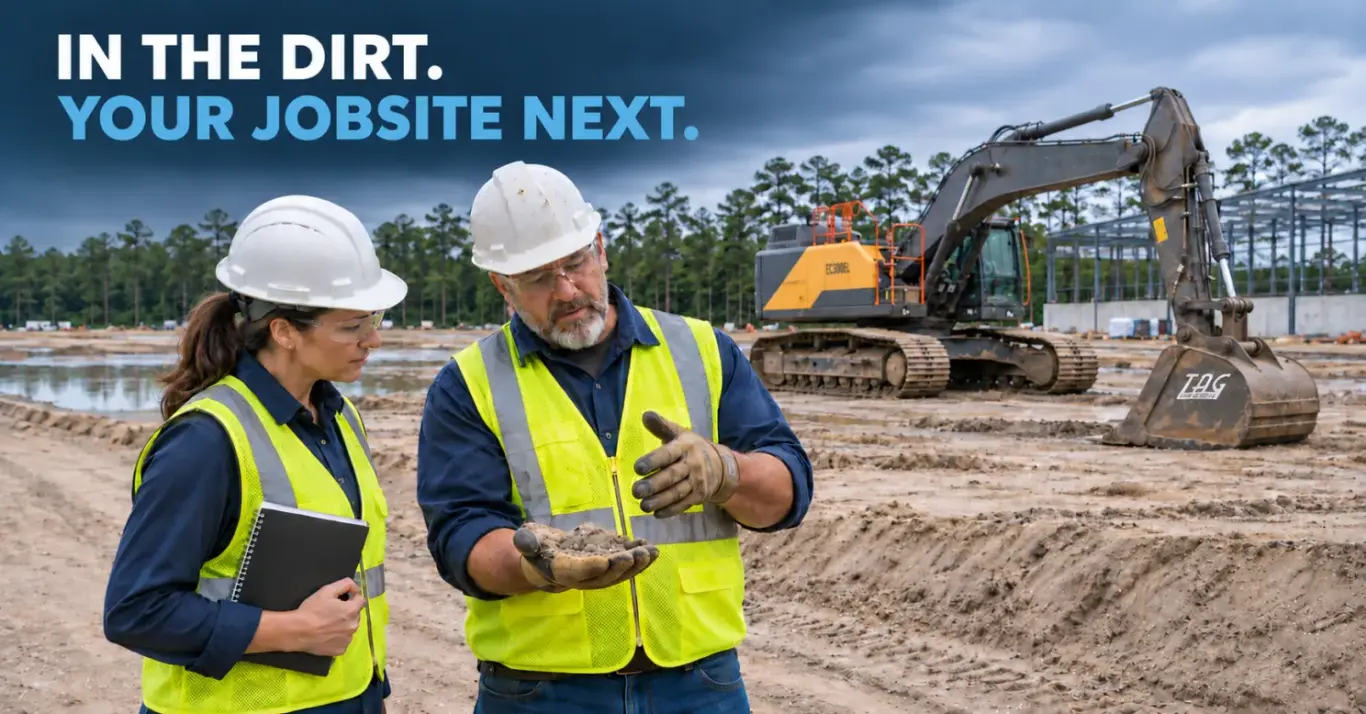
“In the Dirt” is our jobsite series. We go to a real job, with a real contractor, in real ground, and ask the people running the machines what the ground does to the equipment. Charleston was the first episode, and the warehouse sitework with Landmark, Ascendum, and Evans gave us sand and water to learn from. [TAG to confirm: link to the “In the Dirt” Low Country video]
If your jobsite has something to teach, we want to see it. That could be frozen ground in the upper Midwest, coral rock in South Florida, caliche (soil cemented hard by calcium carbonate) in Texas, blasted rock on a highway cut, or a tight utility trench in a city street. Tell us the ground, the machines, and what the bucket goes through. Call (888) 490-0501 or write to us through our contact page, and mention “In the Dirt.”
Guides for This Topic
- Excavator Bucket Guide: Duty Classes, Bucket Types, and How to Choose for Your Ground
- Heavy Duty vs Severe Duty vs SXD: Which Bucket Duty Class Fits Your Ground?
- Why Excavator Buckets Wear Out: Wear Strips, Side Plates, Ears, and Teeth Explained
- Ditch Cleaning Bucket vs Digging Bucket: When a Wide, Smooth-Lip Bucket Pays Off
- Is Your Excavator Bucket Worn Out? A 10-Point Inspection Checklist
Talk to the People Who Build It
Not sure which bucket fits your sand? Call (888) 490-0501 or reach the TAG Customer Success Team, and we’ll help you match the duty class and width to your ground. Before you call, have these ready:
- Your machine’s make, model, and weight class
- Your coupler type
- Your pin size, if you know it
- A plain description of your ground, including how wet it is
Every TAG bucket is built in Chattanooga, Tennessee.
Fast. Rugged. Reliable.
Frequently Asked Questions
What kind of excavator bucket is best for sandy soil?
For ordinary sand, a Heavy Duty bucket with a double bottom shell is the usual starting point. For wet, high-silica sand with a high water table, like Charleston’s, ask for a Severe Duty bucket with full side wear plates and replaceable wear strips. If your current bucket’s sides and heel wear faster than its cutting edge, the sand is more abrasive than that bucket was built for.
Why does my excavator bucket wear out so fast in wet sand?
Most sand is largely quartz, which is harder than common abrasion-resistant plate. Water holds that grit against the shell on every pass, and a high water table keeps the sand wet all day. The sides, heel, and underside lose steel faster than they would in loam, because wet quartz sand is far more abrasive.
Do I need a Severe Duty bucket for a mini excavator in sand?
Not always, but machine size is the wrong reason to say no. A mini excavator trenching in wet, high-silica sand drags the same grit across its sides as a larger machine. Our Severe Duty bucket is built for mini and compact excavators in abrasive ground, so if your sand is wet and high in silica, it’s the class to ask for.
What should I check on a bucket that works in sand?
Check the side wear plates, the heel, the wear strips, and the teeth. Feel the side wear plates at the cutting edge end whenever you grease the machine, because side wear is hard to see from the cab. Replace teeth before wear reaches the adapter, and replace wear strips while they still protect the underside. Check the ears for bending and the bores for pin-bore wear.
How does a high water table change which bucket I should buy?
A high water table keeps the bucket working wet all day, which makes sand harder on steel and makes the clay layers underneath sticky. Look for a smooth, unobstructed opening and a clean inside shell, so water drains and sticky material dumps. Expect the ground to wear the sides and underside faster than dry ground would, and keep wear parts on hand.
Is a ditch cleaning bucket useful on a sandy sitework job?
Yes, for the grading and cleanup after the trenches are in. A wide, shallow ditch cleaning bucket shapes a drainage ditch or channel in one pass, where a digging bucket takes several bites. In sand, fewer bites mean less wear. Its double-beveled, reversible bolt-on edge takes the wear instead of the shell.