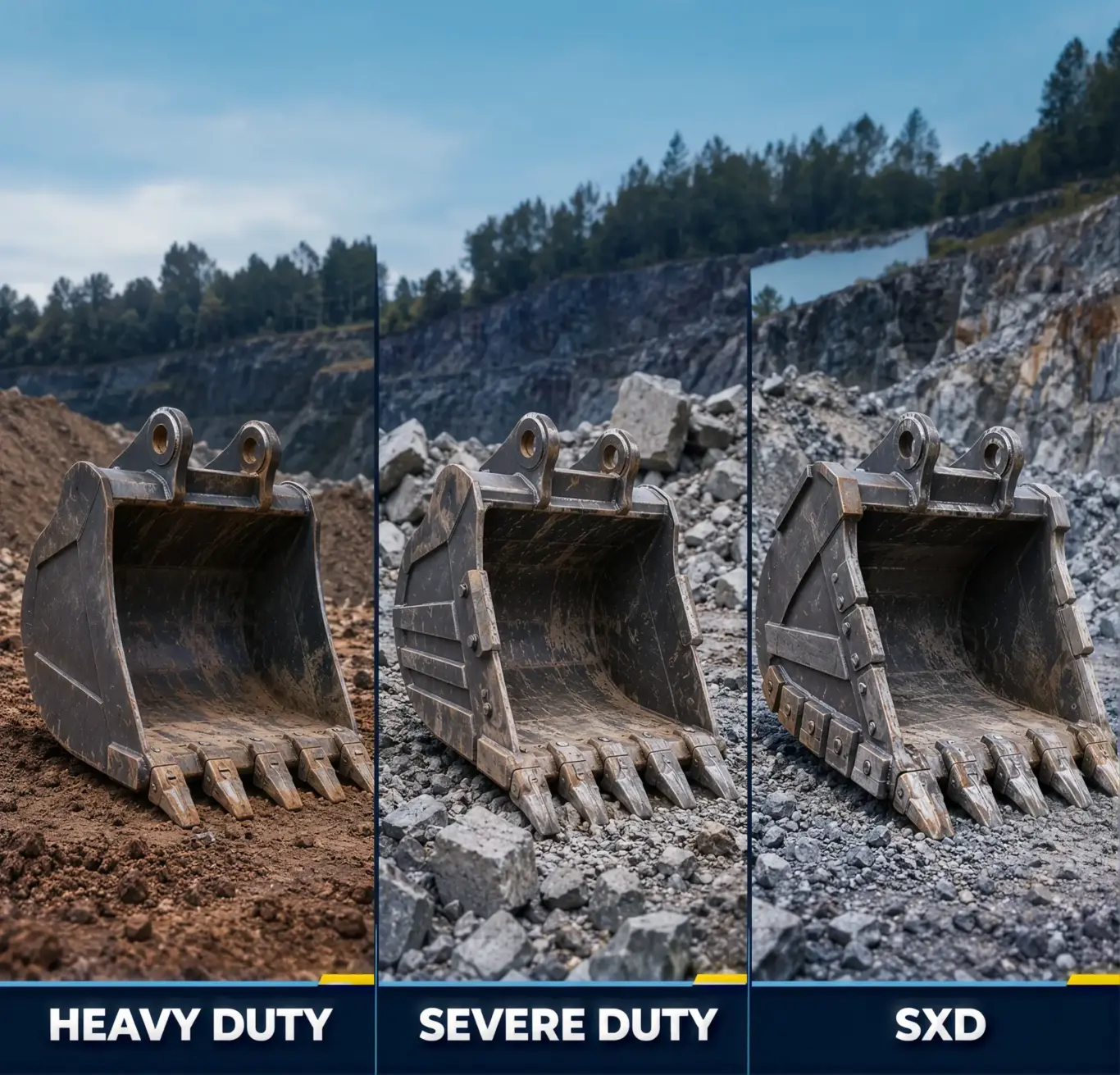
Pick the duty class by how abrasive and how hard-hitting your ground is, not by how big your machine is. Most compact-excavator dirt work in topsoil, loam, clay and mixed fill belongs on a Heavy Duty bucket. Rock, concrete rubble, compacted clay and other ground that eats a standard bucket fast belongs on a Severe Duty bucket. Mining and extreme abrasion belong on an SXD bucket.
That short answer covers most jobs. The rest of this post explains why, what changes in the steel at each step, and what it costs you to guess wrong in either direction. If you are also sorting out bucket type and width, start with our excavator bucket guide and come back here for the duty-class decision.
A 3-ton machine in shot rock needs a tougher bucket than a 20-ton machine in loam. Machine size sets your width and pin dimensions. Ground sets your duty class.
How does the industry define bucket duty classes?
Duty class is a measure of how much wear and impact a bucket is built to take, and the industry sorts it by the material you dig. The usual framing has three tiers: a heavy or general tier for low-to-moderate abrasion, a severe tier for highly abrasive or rocky ground, and an extreme tier for mining-grade abrasion. Makers name the tiers differently, but the logic is the same everywhere.
A widely cited guide on choosing an excavator bucket classifies common materials into different duty tiers. Topsoil, loam, coal, sand, clay, gravel, shale, and limestone fall under heavy duty for most applications. High-silica sand, caliche, and shot granite call for severe-duty buckets, while slag, sandstone, quartzite, and ore fall into the extreme-duty category.
Two things drive that sorting: abrasiveness and impact. Abrasiveness is how fast a material sands away steel on every pass; sharp, hard grains such as silica sand and crushed granite cut steel on each stroke, which is why one cubic yard of “sand” can be easy and another brutal. Impact is the shock load from hitting rock, rebar, broken concrete or frost with the lip and heel, and it stresses welds and the frame rather than the skin.
Those two forces damage different parts of the bucket. Abrasion thins the floor, the side plates, the cutting edge and the heel. Impact cracks welds at the ears, the back plate and the corners of the shell. A duty class is a bundle of answers to both.
The practical test is simple. Ask what the bucket is dragging through, and ask what the bucket is hitting. If both answers are “soil,” you are in Heavy Duty country. If either answer involves rock, rubble or frozen ground, keep reading.
What changes structurally at each step?
Each step up a duty class adds material where the bucket wears or cracks first, and in the Severe Duty and SXD tiers it adds parts you can replace instead of the bucket. The specifics below come from TAG’s three excavator bucket lines. The design logic applies to any well-built bucket; the parts list is ours.
Heavy Duty: the structure most dirt work needs
A TAG Heavy Duty excavator bucket is built around four features: double bottom bucket shells, smooth, unobstructed openings, internal triangle reinforcements, and a double radius and dual taper profile. TAG’s page describes the result as quicker loading times and greater yardage on each pass, with higher strength and fewer failures. Here is what each feature does on a jobsite.
The double bottom shell means the floor you drag through dirt is not the floor that holds the bucket together. Wear on the outer shell does not breach the structural inner shell, so the bucket keeps its shape and its welds while the outside scuffs.
Smooth, unobstructed openings matter at dump time. A throat with no ridges, lips or internal braces lets sticky clay and wet loam fall out cleanly, so you are not shaking the stick at the spoil pile on every cycle. Over a day of trenching, those seconds add up to extra cycles.
Internal triangle reinforcements tie the side plates to the shell at the points where impact tries to spread them. The dual taper and double radius profile shape the bucket so material rolls in on the curl instead of packing in the back. Fill is better and the bucket releases better, which is where the “greater yardage on each pass” claim comes from.
For most compact-excavator work this is the right stopping point. It is not a light-duty bucket. It is a bucket whose structure is sized for soil and whose wear surfaces are not yet built as sacrificial parts.
Severe Duty: wear parts that stand in front of the frame
A TAG Severe Duty excavator bucket is built for mini and compact excavators in abrasive ground: rock, concrete rubble, compacted clay, and any site where a standard-duty bucket wears out fast. It adds four things to the Heavy Duty structure: larger triangles, full-width replaceable transverse wear strips, extended bucket ears, and full side wear plates. The design intent from TAG’s page is that the bucket wears down instead of the frame behind it.
Larger triangles are the answer to impact. When the lip hits a boulder or a slab of concrete, the force travels through the side plates into the back of the bucket. Bigger gussets spread that force over more weld and more plate, which is where cracking starts on a bucket that is too light for the work.
Full-width replaceable transverse wear strips are the answer to abrasion. They run across the floor of the bucket, in the path of every drag, and take the sanding that would otherwise thin the floor itself. When they are worn, you replace a strip, not the bucket.
Full side wear plates do the same job on the sides, which take abrasion every time the bucket enters and leaves the cut and are among the first places a lighter bucket gets thin. Extended bucket ears put more material at the pin bosses, which take every pound of breakout and lift and are expensive to rebuild once they are oval or cracked.
For a detailed look at where buckets wear and what each part protects, read why excavator buckets wear out. The short version is that Severe Duty is the class where “wear” starts to mean “a part you swap” rather than “a bucket you retire.”
SXD: everything in Severe Duty, then thicker and more protected
A TAG SXD excavator bucket is TAG’s Xtreme Duty mining bucket, built for mining and extreme wear applications where the goal is to reduce failures and hold up in the most abrasive environments. It carries every attribute of the Severe Duty line and adds four more: robust torque tubes, replaceable vertical shrouds, replaceable heel protectors, and increased thickness to the shell and cutting edge.
Torque tubes answer the twisting load that comes from digging with one corner of the bucket, which happens every time you pry a rock or work a face at an angle. The tube ties the two sides of the bucket together so the whole structure resists the twist instead of the ear welds taking it alone.
Replaceable vertical shrouds protect the leading vertical edges of the side plates, which take first contact every time the bucket enters hard ground. Replaceable heel protectors cover the bottom rear corner of the shell, the spot that drags across the floor of every cut. Both are parts you replace on a schedule rather than surfaces you watch thin out.
Increased thickness to the shell and cutting edge is the plainest change of the four. Thicker steel takes longer to wear through. In ore, slag or quartzite, where even hardened wear parts go fast, that extra thickness is the margin between a bucket that reaches its next wear-part change and one that does not. [TAG to confirm: shell and cutting edge thickness difference between Severe Duty and SXD in a given width]
What does it cost to pick the wrong class?
Guessing wrong costs money in both directions, and the under-spec mistake is the more common and the more expensive one. Over-spec means you carry weight you do not need on every cycle. Under-spec means you wear through a bucket early and risk damage to the frame, the ears and the machine’s own pins.
Over-spec: weight you carry on every cycle
A heavier bucket takes lift and tipping capacity that could have been payload. Industry-general figures from the Werk-Brau guide put a severe-duty bucket at roughly 20 percent heavier than a heavy-duty bucket of the same size, with side plates around 40 percent thicker. Those are industry numbers, not TAG specs, but the direction is universal.
On a 1.5-ton or 3-ton machine that weight shows up fast. The machine has a fixed amount of hydraulic lift at a given reach, and the bucket’s own weight comes off the top of it before you put anything in it. If the heavier bucket forces smaller bites to stay inside the lift chart, payload per cycle drops, cycle count rises, and fuel per yard rises with it.
United Rentals publishes a quick lift check that is worth running before any bucket change: multiply bucket capacity by material density, add the attachment’s weight, and divide by the machine’s adjusted lift capacity at the reach you work at. If the result is under 1, the combination is within the chart. If it is near or over 1, the bucket is too heavy or too big for that machine at that reach. [Engineering review required]
United Rentals also makes a point that matters for over-spec thinking: breakout force comes from the machine’s hydraulics, not from the bucket. A tougher bucket does not dig harder. It survives harder digging. If you are reaching for SXD because the Severe Duty bucket “does not dig well enough” in clay, the fix is usually tooth profile or technique, not duty class.
Under-spec: wear now, structural damage later
Under-spec starts as a wear problem and turns into a structural problem. In abrasive ground, a Heavy Duty bucket thins at the floor, the side plates and the heel. Once that sacrificial material is gone, abrasion starts on the parts that hold the bucket together, and impact starts cracking welds that were sized for soil. At that point the repair is no longer a wear strip but a cut-and-weld job on the shell or an ear rebuild, with the bucket off the machine while it happens.
Downtime is the real cost. The Werk-Brau guide estimates that the wrong attachment can add 10 to 20 percent to a project’s cost, and most of that is time rather than steel. A bucket in the shop is a machine that is parked, and a parked machine on a trenching job is a crew standing around.
Under-spec also changes the warranty conversation. TAG’s one-year warranty against defects in material and workmanship excludes normal wear and products that have been misapplied or misused. A Heavy Duty bucket run in shot rock until the floor is gone is a misapplication, not a defect.
Heavy Duty vs Severe Duty vs SXD at a glance
| Heavy Duty | Severe Duty | SXD | |
|---|---|---|---|
| Built for | General excavation in soil with low-to-moderate abrasion and occasional impact | Mini and compact excavators in abrasive ground where a standard-duty bucket wears out fast | Mining and extreme wear applications in the most abrasive environments |
| Ground examples (industry-general) | Topsoil, loam, sand, clay, gravel, shale, limestone | Rock, concrete rubble, compacted clay, high-silica sand, caliche, shot granite | Slag, sandstone, quartzite, ore |
| Key structural features | Double bottom bucket shells; smooth, unobstructed openings; internal triangle reinforcements; double radius and dual taper profile | All Heavy Duty features plus larger triangles, extended bucket ears, full side wear plates | All Severe Duty features plus robust torque tubes and increased thickness to shell and cutting edge |
| Replaceable wear parts | None listed as replaceable; the outer shell takes the wear | Full-width replaceable transverse wear strips | Transverse wear strips plus replaceable vertical shrouds and replaceable heel protectors |
| Relative weight | Baseline for a given width | Heavier than Heavy Duty; industry sources put severe-duty buckets at roughly 20% heavier, TAG figure not published | Heaviest of the three; TAG figure not published |
How to read this table: start in the “Ground examples” row, find the material you dig most days, and read up to the class; the feature rows then tell you what you are paying for at that step and what you can replace instead of retiring the bucket. The ground examples follow the industry-general sorting from the Werk-Brau guide linked above, and the Severe Duty column adds the materials TAG names on its own product page. The weight row is directional only; [TAG to confirm: typical weight difference between Heavy Duty, Severe Duty and SXD at a common compact-class width].
Which duty class fits your ground? Five jobsite scenarios
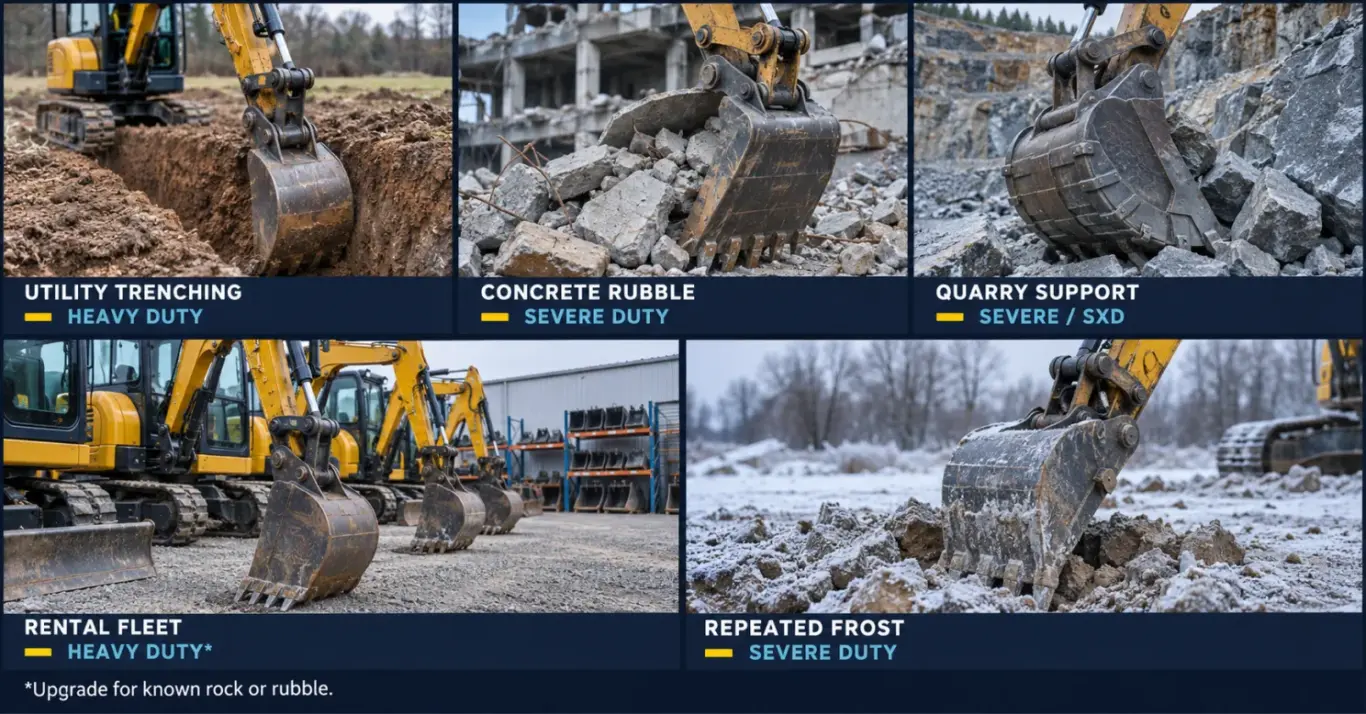
The right class is the one that matches the worst ground the bucket will see regularly, not the average ground. Here are five common situations, the class we would point to, and the reason.
A utility contractor trenching in loam and clay
If your days are water, sewer and conduit trenches in loam, topsoil, clay and ordinary fill on a 3-to-8-ton machine, a Heavy Duty bucket fits. The ground is low-abrasion, impact is occasional (a buried rock, an old footing), and your cost per foot depends on cycle speed and clean dump more than on wear life. The smooth opening and the double radius profile are the features that pay here, because they turn into more feet of trench per hour.
Step up to Severe Duty only if your “clay” is really compacted clay with embedded gravel, or if your region’s fill is full of broken concrete and brick. Compacted clay is on TAG’s Severe Duty list for a reason: it is hard enough to hammer the lip and gritty enough to sand the floor. If you are replacing Heavy Duty buckets more than once a season on the same ground, that is the tell.
A demolition contractor loading concrete rubble
Concrete rubble is the textbook Severe Duty case. It is abrasive because crushed concrete is mostly sharp aggregate, and it is high-impact because you are hitting slabs, rebar and footings with the lip and the heel on every bite. A Heavy Duty bucket in rubble thins at the floor and cracks at the ears. A Severe Duty bucket puts replaceable wear strips in the path of the abrasion and larger triangles and extended ears in the path of the impact.
If the work is heavy structural demo with a lot of prying, or the rubble includes slag or refractory brick, look at SXD for its torque tubes and heel protectors. For most demo on compact machines, Severe Duty is the answer.
A quarry or aggregate yard running support work in shot rock
Shot rock is where Severe Duty becomes the floor rather than the ceiling. Blasted granite is both abrasive and high-impact, and a compact excavator doing cleanup, ditch work or loading around a quarry face is in it every day. Severe Duty is the minimum; the decision is whether the rock type pushes you to SXD.
The industry-general sorting settles it. Shot granite lands in the severe tier; quartzite, sandstone, ore and slag land in the extreme tier. If your quarry is granite or limestone, start with Severe Duty and track the wear strips. If it is quartzite, or an ore or slag environment, SXD’s thicker shell and cutting edge plus the replaceable shrouds and heel protectors are built for exactly that.
A rental yard with a mixed fleet and unknown jobs
A rental fleet cannot know the ground in advance, so the question becomes which class protects the bucket across the widest range of renters. Heavy Duty is the sensible default for the bulk of a compact fleet, because most rental hours go to utility, landscape and site prep in soil.
Stock Severe Duty for the sizes and branches that see rubble, rock or compacted ground often enough that Heavy Duty buckets come back thin; your own repair tickets will tell you which sizes those are. For a customer heading into known rock, a Severe Duty bucket on the machine is cheaper than the damage claim after the fact.
A contractor working frost and frozen ground
Frozen ground is an impact problem first. A Heavy Duty bucket will handle a few weeks of surface frost a year, but a long winter of punching through a frozen crust every morning is repeated shock to the lip, the ears and the triangle gussets. For that, Severe Duty’s larger triangles and extended ears are built for the repeated hit.
Frost often calls for a different bucket type before it calls for a different duty class. Penetration teeth or a rock-profile bucket get the lip through the crust with fewer hits per bite. Our excavator bucket guide covers rock and specialty bucket types for frozen and hardpack ground.
When should you step up a class mid-life?
Step up a class when the same ground has worn out a bucket faster than its expected life, or when inspection shows wear reaching structure rather than skin. The first bucket on a new type of ground is a test. The second bucket is where you apply what the first one taught you.
Published repair guidance gives you thresholds to work from. A Construction Equipment guide to bucket wear suggests a new bucket rather than more repairs when repair cost reaches around 40 to 50 percent of new, when shell wear exceeds roughly a quarter inch, or when weld cracks appear. The same guide reports one published example in which a delayed cutting edge replacement of a few hundred dollars became a bucket replacement that cost thousands.
Those thresholds tell you when to replace, not what to replace with. If a Heavy Duty bucket hit them in ground you still work, another Heavy Duty bucket repeats the experiment. That is the moment to move to Severe Duty, because the wear strips and side plates will now take the abrasion that just cost you a bucket.
Watch three signs in particular. Floor wear that reaches the inner shell on a double-bottom bucket means the ground is more abrasive than the class assumes. Cracks starting at the ears or at the triangle welds mean impact is above what the class assumes. Side plates that go flush with the shell in a single season mean you need plates that are designed to be replaced.
Our 10-point excavator bucket inspection checklist walks through measuring plate thickness, marking crack ends and checking pin bores so you can make this call with numbers rather than a hunch. Run it on the bucket coming off the machine and the decision about the bucket going on will usually make itself.
The reverse move is also worth making. If a Severe Duty bucket comes off a season of loam-and-clay work with its wear strips barely touched, and the machine lives in that ground, a Heavy Duty bucket would carry the same yardage with less weight. Keep the Severe Duty bucket for the jobs that need it.
Frequently asked questions
What is the difference between a heavy duty and a severe duty excavator bucket?
A Heavy Duty bucket is built for general excavation in soil, with a double bottom shell and internal reinforcements sized for low-to-moderate abrasion. A Severe Duty bucket adds replaceable wear strips, full side wear plates, larger triangles and extended ears so that the bucket wears down instead of the frame behind it. The practical difference is that in rock, rubble or compacted clay you replace wear parts on a Severe Duty bucket rather than retiring the bucket.
Do I need a severe duty bucket for my mini excavator?
You need one if the ground is abrasive or high-impact, not because the machine is small. TAG’s Severe Duty bucket is built specifically for mini and compact excavators working in rock, concrete rubble and compacted clay. If your mini excavator spends its hours in loam, topsoil and ordinary fill, a Heavy Duty bucket is lighter and keeps more of the machine’s lift for payload. Match the class to the ground.
What does SXD mean on an excavator bucket?
SXD is TAG’s Xtreme Duty mining bucket. It carries every feature of the Severe Duty line and adds robust torque tubes, replaceable vertical shrouds, replaceable heel protectors, and increased thickness to the shell and cutting edge. It is built for mining and extreme wear applications such as ore, slag and quartzite, where even a Severe Duty bucket’s wear parts go fast. Most compact-excavator construction work does not need SXD.
Is a severe duty bucket heavier than a heavy duty bucket?
Yes. The added side plates, wear strips, larger triangles and extended ears all add steel. Industry-general figures put a severe-duty bucket at roughly 20 percent heavier than a heavy-duty bucket of the same size, though TAG does not publish weights for its lines. That extra weight comes off your machine’s lift capacity before you put anything in the bucket, which is why you should only step up a class when the ground calls for it.
Can a severe duty bucket dig harder than a heavy duty bucket?
No, because breakout force comes from the machine’s hydraulics and the bucket’s geometry, not from the duty class. A Severe Duty bucket survives hard digging; it does not create it. If your bucket is struggling to penetrate hard clay or frost, the usual fixes are a different tooth profile, a narrower bucket or a rock-style bucket, not a heavier duty class. Duty class is about wear and impact life.
How do I know when to upgrade from heavy duty to severe duty?
Upgrade when a Heavy Duty bucket wears out early on ground you will keep working. The signs are floor wear reaching the inner shell, cracks starting at the ears or triangle welds, and side plates going flush with the shell in a single season. Published repair guidance suggests replacing a bucket when repairs reach about 40 to 50 percent of new cost. When that happens, replace it with the next class up, not the same one.