A rental yard with 40 compact excavators from three manufacturers can have a full bucket rack and still turn a customer away, because every 18-inch bucket on the shelf is pinned for the wrong brand. That’s where the pin grabber vs dedicated coupler question starts. If you run a compact rental fleet and buy your own buckets, standardize on one dedicated coupler pattern across every brand. Keep pin grabbers for the machines that have to pick up buckets you didn’t choose.
A single dedicated pattern gives you a tighter fit, less added length at the bucket tip, and one bucket that hangs on every machine in the class. Below, we cover what each coupler family costs you, how the bucket rack changes under each standard, and how to switch a yard over. If you’re still sorting out which coupler families exist, start with our quick coupler buyer’s guide.
Why Is This a Fleet Problem and Not a Machine Problem?
Coupler choice becomes a fleet problem because the coupler decides which buckets can go on which machines. With one excavator, you pick what fits the machine and the buckets that came with it. With 40, every coupler decision turns into an inventory decision, and buckets are where the money and the shelf space go. Any plan to standardize excavator buckets across brands starts with the coupler.
Skid steers settled this long ago with a common quick-attach plate. Compact excavators never did. Each machine maker went its own way with its own coupler and bucket interface, and none of them designed for a yard that buys from three makers.
A bucket can also pin up and still be wrong for the machine. In a ForConstructionPros article on mini excavator attachments, United Rentals advises renters to confirm that an attachment works with the machine before they rent it, because some buckets add significant weight and don’t suit the smallest models.
Our advice is to keep a written list of approved machine and attachment pairings, so the choice isn’t left to whoever is working the rental counter that morning. Build that list whichever coupler you pick.
The real question, then, isn’t which coupler is best. It’s how many separate bucket pools you want to own. Every distinct interface on the lot is its own pool, and pools don’t share buckets.
What Does a Pin Grabber Grab?
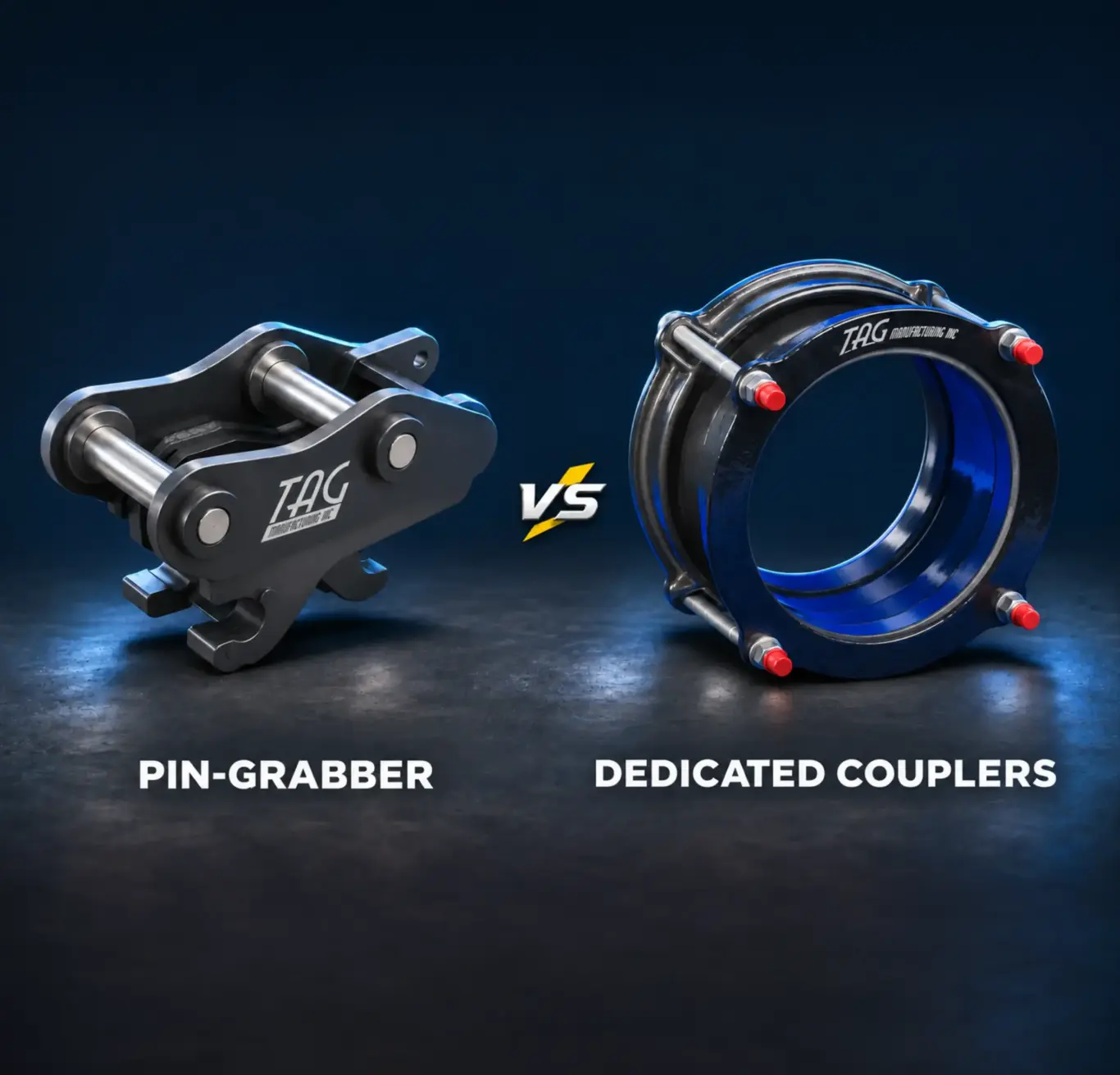
A pin grabber grabs the bucket’s own pins, so it doesn’t care which machine the bucket was built for. A fixed hook takes one pin, and a latch or moving jaw closes on the other. The bucket hangs from the coupler much as it would hang from the stick if you’d driven the pins by hand. That’s why a pin grabber coupler appeals to a rental fleet: the pin-on buckets you already own can go on any machine whose coupler can reach their pins.
Reach is the catch. No pin grabber is sized by a single number. Each one works inside three windows: the range of pin spreads it can open and close across, the width it can fit between the bucket ears, and the pin diameter its jaws were shaped for. A bucket has to land inside all three at once, so check each coupler’s published ranges against the measured pins on the buckets you own.
Pin grabbers do two more things a rental yard likes. Most will pick up a bucket reversed, facing the cab, for the jobs that call for it. They can also take a customer’s own bucket. A contractor who shows up with a pin-on bucket from his last machine can often hang it on yours if the pins land in range, and that beats sending him down the road.
Our Pin Grabbers by Machine Size
The Mechanical Pin Grabber Coupler comes in two styles, split by machine size. The Spring Latch style fits rubber tire backhoes and compact excavators from 2 to 8 tons [TAG to confirm: pin diameter and pin spread pick-up range for each Spring Latch size]. The Screw & Hitch Slide style fits full-size excavators from 12 to 20 tons.
The Hydraulic Multi-Lock Coupler is a hydraulic pin grabber built by Dromone, and we’re the exclusive North American distributor of Dromone quick couplers. It fits machines from 2 to 120 tons, and the operator runs it from two buttons in the cab.
What Makes a Coupler Dedicated?
A coupler is dedicated when it’s built to meet one interface on the attachment and nothing else. The bucket carries hooks, ears, or a wedge pocket in fixed places, and the coupler is shaped to match them. Because it doesn’t have to reach for pins at different spreads, a dedicated coupler can sit closer to the stick. That keeps the bucket nearer the geometry the machine was designed around, with less added length at the tip and less breakout force given up.
The trade is that a dedicated coupler only picks up buckets that carry its interface. A pin-on bucket won’t hang on it as it stands.
Most compact excavator makers offer a dedicated pattern of their own, such as the Deere Wedge, the Kubota Quick Attach, and the Bobcat X-Change. Wedge designs also take up their own wear. As the wedge and its pocket wear, the wedge travels farther into the pocket and closes the gap.
Here’s the catch for a rental yard. Each OEM pattern belongs to one machine brand, so a Deere Wedge bucket is a bucket for Deere machines. That’s no problem for a contractor who runs one brand. A yard with three brands on the line, though, is back to three bucket pools.
The TAG QC Coupler: A Dedicated Pattern Without a Brand
The TAG QC Coupler is a dedicated coupler whose pattern doesn’t belong to any machine brand. It comes in two models. The QC27 is for mini and compact machines, and the QC30 handles heavier attachments on full-size excavators. Both use our Adjust-A-Hook design to lock buckets, thumbs, and other attachments onto the machine without leaving the cab [TAG to confirm: one-line description of what Adjust-A-Hook adjusts, and how]. We build and machine both models in Chattanooga, Tennessee.
Fit a QC27 to every machine in a compact fleet [TAG to confirm: OEM makes and models the QC27 is currently offered for], and the same TAG QC bucket hangs on all of them. That was the goal when our cofounder Gary Wilt first sketched the QC27 on a napkin. Takeuchi was the first OEM to adopt the QC27 as part of its offering to national rental companies. As we describe in our story of that partnership, the TAG Quick Coupler System is the preferred setup for United Rentals, Sunbelt Rentals, and other national fleets running 2 to 6 ton compact excavators.
Where Does a Pin Grabber’s Flexibility Cost You?
A pin grabber’s flexibility costs you length at the tip, weight at the end of the stick, and a looser fit as buckets wear. All three come from the same design choice. A coupler that can reach any pin needs room to adjust between the stick and the bucket.
Added Length and Breakout Force
Almost every quick coupler adds some length between the stick and the bucket tip, and a longer tip radius means less breakout force at the teeth. Tip radius is the distance from the bucket pivot pin to the tooth tips. A pin grabber, built to open and close across a range of pins, usually adds the most. Most contractors accept some loss in exchange for faster swaps, and a compact coupler design keeps that loss smaller.
The penalty hurts more on small machines, and simple arithmetic shows why. Say a 3-ton machine has a 30-inch tip radius and a pin grabber adds 5 inches, which makes the lever about 17 percent longer. Put the same 5 inches on a 30-ton machine with a 70-inch tip radius, and the lever grows only about 7 percent. These are round numbers we’ve assumed for illustration, not measured figures or TAG specifications, so measure your own machines.
In simple lever terms, a lever 17 percent longer leaves the teeth with roughly 14 percent less of the bucket cylinder’s force, because the cylinder doesn’t get any stronger when the lever gets longer. The real figure differs on every machine, because the linkage geometry changes it. Nobody notices the loss in loose fill, but the operator feels it on the last foot of a trench in hard clay.
Weight at the End of the Stick
Every pound of coupler hangs at the far end of the stick, and that weight comes off what the machine can lift and carry. Compare coupler weights before you pick a standard [TAG to confirm: published weights for the QC27 and for each Spring Latch pin grabber size]. Check the lift chart with the coupler fitted, not without it [Engineering review required].
Fit as Buckets Wear
A pin grabber clamps whatever pins it’s handed, so a worn bucket gives it a loose part to hold. Pin movement wears the bores oval over time, and the pins wear where the coupler jaws bear on them. After a few hundred rentals, the signs are easy to spot:
- A clunk at the end of every curl. The bucket moves on its pins before the cylinder takes up the load.
- A bucket that shifts when the operator changes direction. The pins have play in their bores.
- Bores worn oval. New pins alone won’t take out pin-bore wear, so the bores need repair before the bucket goes back in service.
- Flat or shiny spots on the pins. The pins are wearing where the jaws close on them, and they’ll keep loosening the fit.
A dedicated interface wears too, but it wears against parts made to meet each other.
Where Does a Dedicated Coupler Cost You?
A dedicated coupler costs you up front, on lead time, and at the rental counter.
Buckets. Every bucket has to carry the interface. If your rack is full of pin-on buckets, going dedicated means replacing them or converting them [TAG to confirm: whether TAG converts existing pin-on buckets to the TAG QC interface, and for which sizes]. That’s real money, and unless you phase it, it lands in one budget year.
Lead time. Once you’re on one pattern, next week’s bucket has to come from someone who builds that pattern. If the quote is weeks out, the machine either sits or goes out with the wrong bucket. We offer stocking and replenishment programs to dealers and rental companies for exactly this reason [TAG to confirm: current lead time for TAG QC buckets and couplers, and how the stocking program works for a rental account].
Customer buckets. You give up the walk-in customer’s pin-on bucket, which a pin grabber could often take.
There’s a fair case for the other side. In a Rental Equipment Register article on compact excavators in rental, a utility product manager at Volvo Construction Equipment said rental houses should “go with a pin grabber-style quick coupler” because it works across a variety of attachments. For a yard that can’t control which buckets come through the gate, that’s sound advice.
The same manager made a point both camps agree on. A coupler is easier for renters and rental houses to maintain than pin-on attachments, because nobody is knocking out pins, shimming them badly, or skipping the grease.
A dedicated pattern asks you to commit now. A pin grabber lets you put the decision off. That’s its biggest strength for a rental fleet, and it’s also the reason the bucket rack never gets simpler.
What Happens to the Bucket Rack Under Each Standard?
The bucket rack shrinks the most under one dedicated pattern, because every bucket fits every machine. Here’s a worked example for a made-up yard, with every figure assumed to keep the arithmetic easy.
- 40 compact excavators in the 3 to 4 ton class: 16 from brand A, 14 from brand B, and 10 from brand C.
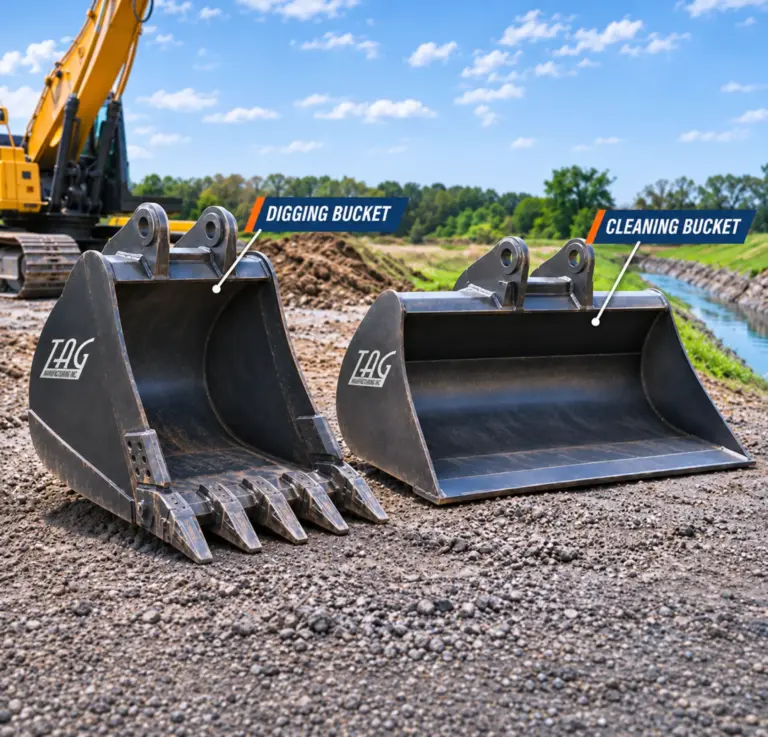
- Five tools on the rental menu: 12-inch, 18-inch, and 24-inch digging buckets, a ditch cleaning bucket, and a ripper.
- A stocking rule of one of each tool for every four machines in a pool, rounded up, plus one spare per SKU.
- Under the pin grabber plan, brand A and brand B bucket pins fall inside one coupler’s pick-up range, and brand C’s don’t. That’s pure assumption, so check your own.
Status quo, three patterns. Brand A’s 16 machines need four of each tool plus a spare, so five. Brand B’s 14 machines round up to four plus a spare, so five. Brand C’s 10 machines round up to three plus a spare, so four. That’s 14 of each tool, or 70 attachments across 15 SKUs.
Pin grabber on every machine. Brands A and B pool together, and their 30 machines round up to eight of each tool plus a spare, so nine. Brand C still stands alone at four. That’s 13 of each tool, or 65 attachments across 10 SKUs.
One dedicated pattern on every machine. All 40 machines share one pool. That’s 10 of each tool plus a spare, so 11, for 55 attachments across five SKUs.
| Status quo (three patterns) | Pin grabber on every machine | One dedicated pattern | |
|---|---|---|---|
| Separate bucket pools | 3 | 2 (assumed) | 1 |
| Bucket SKUs to track | 15 | 10 | 5 |
| Attachments to stock (our rule) | 70 | 65 | 55 |
| Existing buckets that still work | All, on their own brand | Those inside the pick-up range | Only those with the interface, or converted |
| Customer-owned pin-on buckets | Own brand only | If the pins land in range | No |
| Added length at the tip | None if pinned on, varies with OEM couplers | Most, varies by coupler | Less [TAG to confirm: QC27 added tip radius against a typical compact pin grabber] |
The 15-attachment gap between the first and last columns is the headline, but the bigger gain shows up at the counter. Picture three 18-inch buckets left on the shelf, two pinned for brand B and one for brand C, and a customer renting a brand A machine. Under the status quo, you say no, offer a 24-inch bucket, or call the next branch.
With pin grabbers, the two brand B buckets go on if their pins are in range. On one dedicated pattern, all three fit, and the rental takes thirty seconds. Multiply that by every busy weekend, and the SKU count stops being an accounting number.
How Do You Convert Without Adding a Fourth Pool?
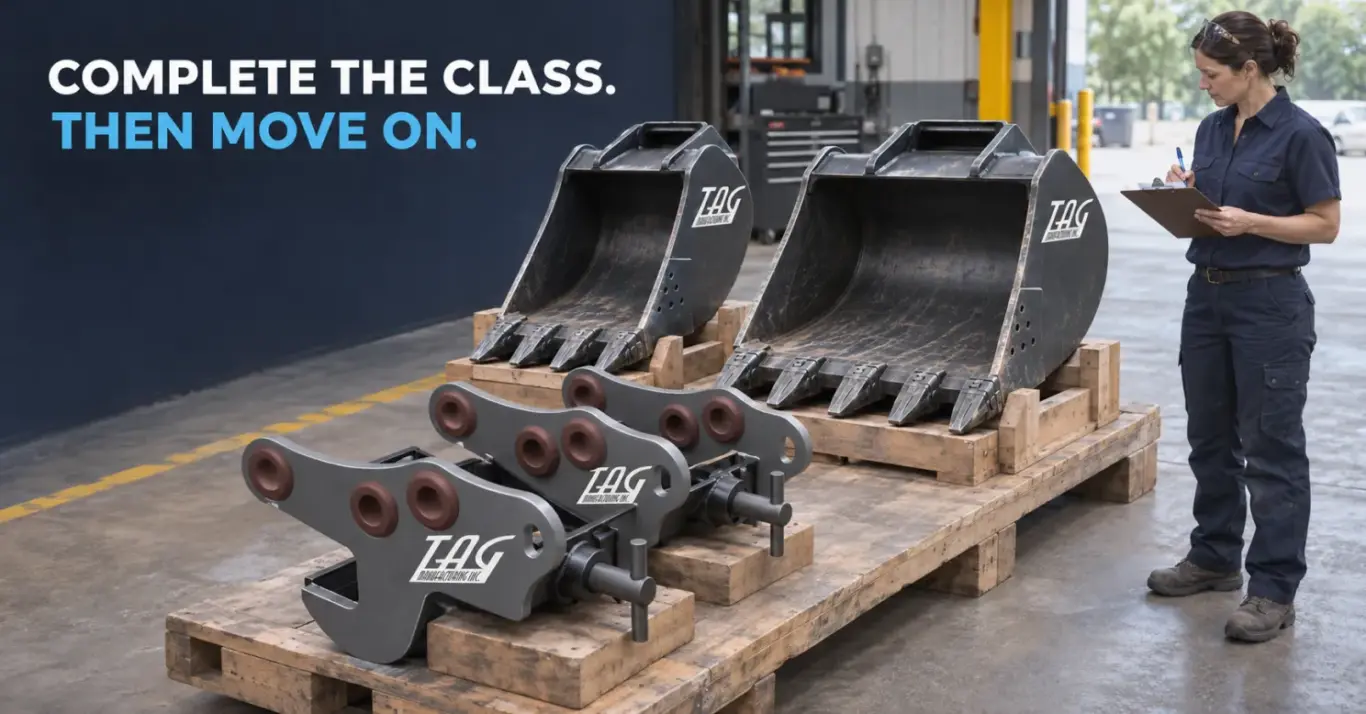
Convert one weight class at a time, and finish each class before you start the next. A half-converted fleet is the worst of the lot. Add a dedicated pattern to the yard and leave the old buckets in service on the old machines, and you haven’t gone from three pools to one. You’ve gone from three to four.
Slow turnover is the trap. Say your yard retires and replaces about 12 buckets a year. That’s an assumed figure, so pull your own from your disposal records. Replace each one in the new pattern, and the 70-bucket rack takes about six years to turn over. Even if new machines arrive at the same pace, the yard carries an extra pool for most of those years.
The faster route is to convert a whole class in one budget window. Fit the new coupler to every machine in the class, stock its core buckets in the new pattern, and retire the old buckets for that class together. The class goes from three pools to one in a single step, and nobody at the counter has to remember which machine still runs which bucket.
Decision rule. Convert a class when you can fit every machine in it and stock its core buckets within the same budget window. If you can’t do both, leave the class on its current patterns until you can.
Legacy buckets have three exits. You can sell them, convert them if the size allows it, or keep them in a sunset pool tied to the specific machines that can run them. Give that sunset pool a fixed end date, because a sunset pool with no end date is just a fourth pool.
Pin Grabber vs Dedicated Coupler: Which Should a Rental Fleet Standardize On?
A rental fleet should standardize by weight class, and for most mixed-brand compact classes, the answer is one brand-neutral dedicated pattern.
Compact fleets with more than one brand. This is where a single dedicated pattern pays off best, as long as you buy and control your own buckets. The QC27 was built for exactly this yard. Pair it with TAG QC buckets and convert one class at a time.
One brand, already on that brand’s pattern. Don’t change anything. Stay on the pattern you have and buy buckets to suit. Our OEM Style Quick Coupler Buckets are built for compact excavators with John Deere Wedge, Kubota Quick Attach, or Bobcat X-Change couplers, which covers a lot of single-brand yards.
A big stock of pin-on buckets, customers who bring their own, or no room for lead times. Pin grabbers earn their place here. On compact excavators and backhoes, that means the Spring Latch mechanical style, and on 12 to 20 ton excavators, it means the Screw & Hitch Slide style. Where machines swap often enough that climbing out gets old, the Hydraulic Multi-Lock Coupler does the same job from the seat.
Full-size machines. A duplicate bucket for a 25-ton machine is a much bigger purchase than one for a 3-ton machine, and the attachments that come through the yard vary more. The pin grabber’s flexibility often earns its weight there, and the Multi-Lock covers machines up to 120 tons. Where the fleet owns its heavy buckets and wants a matched interface, the QC30 is our dedicated option for heavier attachments on full-size excavators.
Can a fleet run both? Yes, as long as you split the standards by weight class and never inside one. Putting compact machines on one dedicated pattern and full-size machines on pin grabbers is a standard. Running two patterns inside the 3-ton class is a mess with paperwork.
Should Rental Couplers Be Mechanical or Hydraulic?
Hydraulic is usually the better choice for rental machines that swap attachments often and go out to operators you don’t know, because the lock is worked from the seat. Our post on mechanical vs hydraulic quick couplers covers the full comparison. Here, we focus on what changes when the operator is a renter you’ve never met.
Safe Work Australia’s information sheet on quick hitches explains why that matters. On mechanical and semi-automatic hitches, the operator has to get off the machine to engage the safety system. Because that takes time and effort, the sheet notes, the safety device is sometimes not engaged.
The same sheet names automatic hitches as the preferred system, because the safety device can be engaged and verified from the operating position. That turns the lock into an engineering control instead of a habit.
Hydraulic doesn’t mean hands-off, though. The Hydraulic Multi-Lock Coupler runs on a set routine. The operator powers it on, presses the control button, and curls the attachment into the over-relief position to release the lock. After rolling the attachment out and setting it on the ground, the operator reverses those steps to pick up the next one.
The operator’s manual comes first, before anyone runs the coupler. Before work, the operator visually confirms that the safety pin or prop lock is fully closed and locked. Walk every customer through that check at the counter each time a machine goes out, and use our daily coupler safety checks as the script.
Mechanical couplers still have a place on machines that wear one bucket all week, where the lower price wins. Know which customers you’re handing one to, and show each of them how the lock works before the machine leaves the yard.
How Do You Switch a Yard Over?
Switching a yard over starts with the bucket rack, not the catalog. Work through these steps in order:
- Audit the rack. Count every bucket and record its pattern, pin diameter, pin spread, and width. Measure each one instead of trusting the paint or the sticker, because a bucket that “came off a 3-ton machine” might have come off any of three brands. Our guide to measuring your machine for a coupler covers the matching dimensions on the machine.
- Write the standard down. Keep it to one line per weight class, attach the approved pairings list, and give both to everyone who touches a rental contract.
- Spec the new coupler on every machine order. New machines then arrive ready for the standard instead of adding to the old pools.
- Mark buckets by pattern. Paint, a tag, or a stamped plate on the bucket ears lets a yard hand tell the pattern at a glance.
- Put the lock check in the hand-off. Show every customer how to confirm the attachment is locked, whatever coupler you chose.
For the wider version of this exercise across loaders, backhoes, and attachments beyond buckets, see our guide to standardizing attachments in a mixed rental fleet. If you’re weighing a TAG QC bucket against an OEM-style coupler bucket for one machine, our comparison of TAG QC buckets and OEM-style coupler buckets walks through that choice.
Guides for This Topic
- Quick Couplers for Excavators, Backhoes, and Wheel Loaders: A Buyer’s Guide
- Mechanical vs Hydraulic Quick Couplers: Cost, Cycle Time, and Operator Safety
- How to Measure Your Machine for a Coupler: Pin Diameter, Pin Spread, and Stick Width
- Quick Coupler Safety: Daily Checks and How to Confirm a Locked Attachment
- From a Napkin Sketch to a Rental Standard: How the QC27 Coupler Simplified Compact Fleets
- TAG QC Buckets vs OEM-Style Coupler Buckets: Matching Buckets to Your Coupler
- Standardizing Attachments Across a Mixed Rental Fleet
Talk to the People Who Build It
Call (888) 490-0501 or reach the TAG Customer Success Team through our contact page, and we’ll help you work out a coupler standard that fits your yard. Our team of 11 has a combined 150-plus years in the industry. Have these ready:
- Your machine list by make, model, and size
- The coupler each machine runs now
- A count of the attachments you own and the pattern each one uses
- Pin sizes, if you have them
Fast. Rugged. Reliable.
Frequently Asked Questions
Will my bucket fit a different excavator?
It depends on how the bucket mounts. A pin-on bucket fits another machine only if its pin diameter, pin spread, and width between the ears match that machine or fall inside the range of its pin grabber. A bucket built for a dedicated pattern fits any machine running that same coupler, whatever the brand. Measure the bucket instead of trusting its label.
What is a dedicated quick coupler?
A dedicated quick coupler is built to meet one interface on the attachment, such as a wedge pocket, a set of hooks, or fixed ears, instead of grabbing whatever pins it’s given. Because it fits only one pattern, it can sit closer to the stick and add less length at the tip. OEM wedge couplers are tied to one machine brand. A brand-neutral dedicated pattern, such as TAG QC, can run across several brands in the same fleet.
Do quick couplers reduce breakout force?
Usually, by a modest amount. Almost every coupler adds some distance between the bucket pivot and the tooth tips, and a longer tip radius means less force at the teeth. Pin grabbers tend to add the most length, and dedicated couplers that keep the bucket close to its original geometry add less. The loss matters most on small machines, where a few inches is a bigger share of the tip radius.
Can I keep my existing buckets if I switch to a dedicated coupler?
Only if they carry the matching interface or can be converted to it. A pin-on bucket won’t hang on a dedicated coupler as it stands. Many fleets keep legacy buckets in a sunset pool on the machines that can still run them, set an end date for that pool, and buy new buckets in the new pattern. Ask us whether your bucket sizes can be converted to the TAG QC interface before you plan around it.
Should a rental fleet use mechanical or hydraulic couplers?
For machines that change attachments often and go out to operators you don’t know, hydraulic is usually the better fit, because the lock is worked from the seat. Mechanical couplers cost less and suit machines that wear one bucket most of the week. Whichever you choose, show every renter how to confirm the attachment is locked before each job, and keep that check in your counter hand-off.
Which machines does the TAG QC27 fit?
The QC27 is the TAG QC Coupler model for mini and compact machines. The TAG Quick Coupler System gives one attachment interface across 2 to 6 ton compact excavators, and the QC30 covers heavier attachments on full-size excavators. Exact fit depends on the make, model, and serial number, so send us your machine list and we’ll confirm each machine before you order.